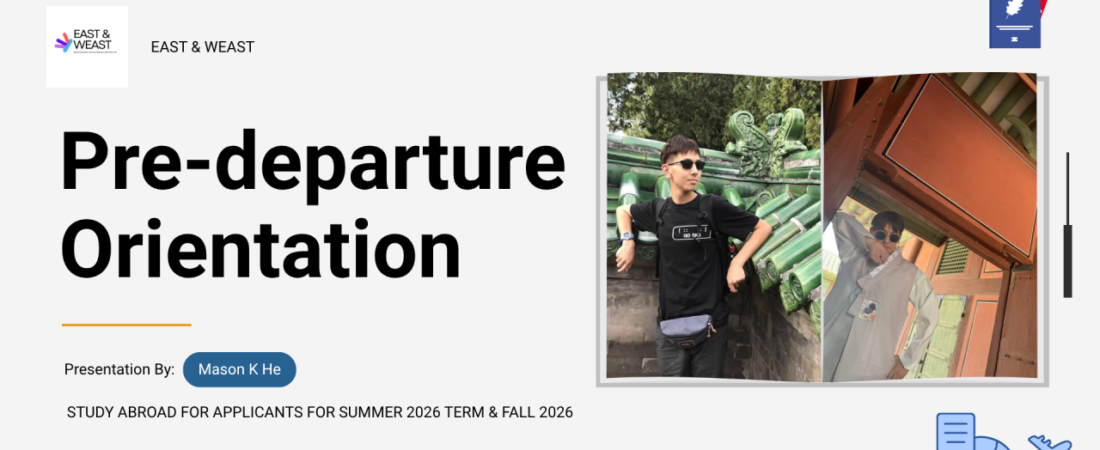
*Note: I recorded a live session reviewing the pre-departure orientation! Feel free to click on this link for the recording, and listen while you read this article!
Welcome to the first Pre-departure orientation for students studying abroad this summer or Fall 2026 by Mason K He. This orientation addresses concerns and procedures to take on your application. As I was a former UCEAP participant, my pre-departure orientation and experiences are based on previous study abroad experience and materials.

As the beginning of the Spring season begins to end and summer/fall 2026 study abroad applications have ended, what can students expect from their next steps for their application and the process in general? I go into more detail on what students should pay attention to throughout the process; this includes planning, reviewing academic guidelines, budget, health and safety, intercultural learning (before, during, and after the program), and most importantly – it’s mostly just making sure the students receives, reads the emails, follow all procedures, and take cultural differences into consideration.
Difference in Study Abroad Centers

Depending on how your academic institution operates and what system they run on, you may have different or separate study abroad department contacts. Each different usually handles different tasks – for example, your study abroad office can help you with major/minor credit, college graduation requirements, help with distributing acceptance letters for your study visa (when applicable), answer any financial aid questions, and handle pre-departure inquiries, visas, calendars, and others. Some institutions may have a systemwide office, in which a student applies for a program via systemwide (UCEAP, CSUIP, SUNY system, etc), and they could handle all pre-departure inquiries, etc. Then, there are students who apply via independent study through different colleges or private organizations not partnered with their home university and require credit transfer approval. Finally, study abroad centers (including third party providers) who have office spaces at the student’s study abroad location will run onsite orientations, assist students with housing, registration, academic culture, and local health professionals if necessary. It is essential to know these differences so the student can know which department to contact for specific questions.
Pre-Departure List 1

For the first part of the pre-departure checklist, please make sure to:
- Check your email for the official pre-departure list
- Make sure to throughly read everything and ask any further questions or concerns to your local study abroad office.
- Students must take their visa application seriously – any missteps or carefully not following instructions may result in missing the visa on time for the program, or sometimes visa rejection from the consulate.
- Students must make sure they follow instructions to secure housing or any logistics. Some students who opt to find housing on their own may be recommended accommodation websites, but they ultimately are responsible for securing their own housing.
- Students are free to contact any alumnus(returnees) or attend onsite info sessions or webinars for more insightful perspectives from previous students who completed their program abroad.
Pre-Departure List 2

Students will most likely set up their account details for any pre-departure/orientation that are expected to proceed online. Furthermore, it is highly advised to pay attention to the flight and housing schedule, and wait for advisor’s permission to purchase flight. Groups who plan to do short term programs and have the group fly together with the instructor may be exempt from this rule as there is a separate process from that.
In case of student’s withdrawal from the program, they must immediately contact their study abroad office and be aware/have known/ and signed an agreement in which they agree that withdrawing from the program during a certain time period will result in completing forms and may need to submit a readmission to university and also may not receive a refund from the program.

Perhaps one of the bigger headaches for students navigating academics during their program. Students must pay attention to:
- GPA – many programs will require students to maintain a certain GPA, minimum usually 2.0 GPA. For more prestigious universities abroad, they may be expected to maintain 3.0 GPA or above.
- If a student is fluent in the study abroad location’s main language and wants to take a course at the host university that is not originally in their home institution’s language, they may need to submit a petition and also prove their fluency to enroll and petition for the course.
- Credits – institutions abroad will operate on a different credit system, thus all courses taken will be conversed and affect the student’s GPA. If the students have the option to opt for P/NP (Pass, No Pass) for one of the courses abroad, they my do so, but note that if a student displays poor performance and receives a poor grade, the grade cannot be made up nor removed from their transcript in most cases.
- Students must pay extra attention to academic code and if they need to take GEs abroad; GEs abroad are typically not as common as taking courses related to the major, as GEs are a bit harder to successfully petition. Also, generally students would have already finished most of their GEs at their home institution during their first two years.

Registrar offices, grade processing, and class registrations typically are different and may clash depending on the circumstance. Additionally, students must be aware of the academic climate in their host university, and how class expectations, behaviors, attitudes, and grading differ. For example, based on my experience at Peking University – classes tend to be on the longer side (can be around 3 or 4 hours with a 5-10 minute break each hour), and lectures in China are usually lecture-based (while you may be 90% time of the time just listen to the instructor, there are still expectations to do group work). Some special notes students may need to be aware: if students need to make adjustments to their program such as withdrawing or extending, they must immediately notify and communicate with their study abroad center or office.
Finding your Budget, Insurance, Financial Aid, and Health Abroad

Students who are thinking of applying or already in the process of applying to study abroad – studying abroad can be expensive. Although students should have already known the estimated breakdown of how much the program would cost and the amount of financial aid (if applied) goes to covering the expenses, it is important to keep note of any withstanding fees and/or know other affiliated costs such as health insurance. If students decide to purchase their own health insurance, the separaye health insurance must be compliant to the standards based on university policy.
Health & Safety: For students who have pre-existing health conditions, they must consult with a doctor and relay all details; this may be important for certain visas that may ask for a health clearance prior to traveling abroad. While the home institution will do their best to provide resources, the students are responsible for medications and laws associated to medicine that are banned from their host country, and emphasize that they must search on their own and avoid calling their insurance provider as rules and regulations change all the time.

For any reminders:

And then… we have culture shock preparation slide for students

Culture shock is part of the process whenever a student is traveling or on a program. In fact, it should be regarded as a positive sign rather than something negative, as it shows some progress for students to learn about various aspects; their identity, how do they understand the world, how does the culture shock affect their perspective of how the world works, what are some things considered unusual in their home country that may be normal in their host country. I listed list of “culture exchange & adaption” practice questions for students diving into the world of culture shock. In a future newsletter, perhaps I will go more on how this relates to inter-cultural learning and tie in my experience.

Why do we encounter culture shocks and how does it impact one’s pre-existing notions of a place or people from that country? There are some ways that students can navigate this journey by asking themselves questions based on the diagram – how can you adapt and what would be your approach to adjusting cross-cultures and stages of culture shock. Here are some reminders for students below on what they an do to address the concerns.


You’re back from your program – whether it was 3 weeks, 3 months, or even 1 year. It is completely understandable that you are now having a difficult time adjusting back to your home country; this is called reverse culture shock for those who may have a difficult time navigating cultural values/lessons they learned abroad and “switching gears” to their “pre study abroad mode”. Sometimes it is better to just simply talk about it and share your experiences. Personally, I recommend to engage and sign up to be a returnee speaker, participant. Thee is nothing more powerful than sharing your own unique experience and contributing to global education at the same time with your voice. If you need additional mental/culture shock help, please check with your campus if they have any campus counseling resources.
I hope you enjoyed my first newsletter of East & Weast – which we will be focusing on education abroad story telling and also working experience abroad story telling. Please let me know if you have any other tips or info you would personally add to your pre-departure orientation list.
Best,
Mason
East & Weast
Chief Editor