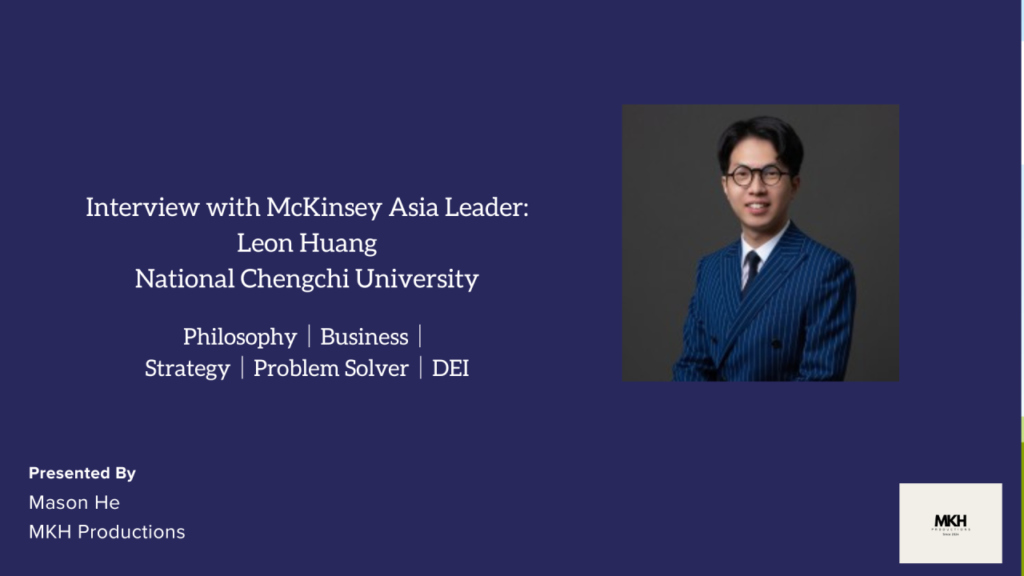
Hello everyone! It’s been awhile since the last edition of MKH Productions. A few months ago, I had the opportunity to interview Leon Huang , who I have met back at the McKinsey Asia Proud Leaders session, and we shared insightful conversations about leaders in Asia. Check out his journey here in the interview below.
1.Can you simply introduce yourself and your background?
Hi this is Leon and my Chinese name is 黃偉俊 I am from Macau and I studied in Macau throughout my primary school, middle school, and high school years. Upon graduating from high school, I went to Taiwan to pursue my college studies. My major is philosophy and I am currently also studying business-related courses.

2. You have such an interesting background of volunteer experience. I want to start off with your previous experience being the head director of NCCULRJ. How did you get involved in this organization and how does it feel to be an advocate for LGBTQIA+ representation at NCCU? How active was the club and was it difficult getting students to attend and be active?
I remember joining the LGBTQIA+ organization shortly after starting my studies in Taiwan. During my first year, I attended the university’s club fair, curious about campus life and eager to learn more about the clubs and organizations available at National Chengchi University.
NCCULRJ, in particular, stood out to me. Established in 1995, it had a legacy of over 20 years in promoting LGBTQIA+ awareness and inclusivity on campus. What drew me in was the opportunity to explore diverse topics such as sexual orientation, patriarchy, feminism, and pansexuality through their workshops and courses. Encouraged by a senior I knew, I decided to join—and what started as curiosity quickly became a meaningful commitment.
Early on, the club president invited me to take on a role within the team. I started as Treasurer, where my responsibilities included managing funds, securing school budgets for activities, working collaboratively with team members, and inviting professors as guest speakers for our events. That role gave me hands-on experience in teamwork and event management, and by the end of the semester, I had the chance to step into the role of Head Director after the president decided to step down.
Becoming the Head Director was a defining moment for me. The club’s mission—to foster social equality and promote awareness—deeply resonated with me. Over the next year, I led our efforts to collaborate with student associations, host impactful events, and engage the broader campus community. While we encountered occasional challenges, including discriminations and criticisms from some organizations, these experiences only reinforced the importance of our work and the need for persistence.
Thanks to financial support from the university, we were able to amplify our efforts through social media. Using platforms like Instagram and Facebook, I experimented with targeted promotions, allocating a modest 1,000 TWD for ads. The results were promising—we attracted attendees not only from our campus but also from other universities across Taipei, Taichung, and Tainan.
Our sessions typically drew 10 to 30 participants, depending on the topic. One of our most successful events focused on Feminism in Korea, which resonated with a wide audience. The timing and relevance of the topic played a significant role in the turnout. What surprised me most, though, was the growing interest we received from teachers and professors, which underscored the broader impact of our work beyond just the student body. Overall, this experience has strengthened my passion for promoting inclusivity and creating positive change—and it continues to inspire the work I do today.

3. How would you compare the LGBTQIA+ representation between you and your hometown in Macau? Any trends you have noticed?(can expand to other APAC countries- Japan, Korea, Thailand, etc)
As someone who grew up in Macau, I’ve observed that LGBTQIA+ topics are rarely discussed openly in my hometown. While there is some awareness, conversations around these topics tend to be limited, largely influenced by cultural norms and governmental restrictions. Similarly, in nearby Hong Kong, the situation is slightly more progressive, with greater representation and occasional public discussions. However, even there, the topic often remains sensitive and isn’t as openly embraced as in some other regions.
Taiwan, on the other hand, stands out as a leader in LGBTQIA+ representation and inclusivity in the Asia-Pacific region. The country’s open discussions, legal milestones like marriage equality, and overall societal acceptance create a more welcoming environment for the LGBTQIA+ community. From my perspective, Taiwan’s progress serves as an inspiring example for neighboring regions and countries.
In Japan, I’ve noticed that there is a level of openness about LGBTQIA+ topics, though my perspective is limited as I haven’t lived there. Public awareness appears to be growing, and representation in media and pop culture seems to be relatively common. However, social expectations and traditional norms may still present challenges for individuals within the community.
When it comes to Mainland China, the situation is notably different. While cities like Chengdu are known for having active LGBTQIA+ communities and underground cultures, broader discussions are often constrained by government policies.
4. You were a former recruiting coordinator for NCCU Green24 Club and helped students learn more about SDGs. As you are also an advocate for DEI, How would you tie this experience along with your other experience as a head director of NCCULRJ to your future career?
My personal experience at NCCU Green24 and NCCULRJ was quite different, but I will say that both experiences share a common theme: advocating for DEI (Diversity, Equity, and Inclusion) in unique ways.
At NCCU Green24, the focus was on sustainability, environmental protection, and promoting veganism. I worked on initiatives to raise awareness about how meat production contributes to environmental harm and encouraged the adoption of healthier, eco-friendly alternatives like plant-based diets. This experience taught me the importance of driving change through education and community engagement, as well as the value of collective action in addressing global issues such as climate change.
On the other hand, my role as President of NCCULRJ came with greater responsibilities and challenges. Leading the organization meant not only fulfilling operational duties but also inspiring a team to uphold the club’s mission of promoting LGBTQIA+ awareness and fostering social equality. This role required strong leadership, strategic decision-making, and the ability to navigate sensitive topics with empathy and confidence.
Both roles shaped my perspective on the interconnectedness of DEI and global challenges. Sustainability, just like inclusivity, requires us to create spaces where diverse voices are heard and respected. Whether it’s advocating for environmental justice or promoting equality within marginalized communities, I see these experiences as foundational to my future career. They’ve equipped me with skills in leadership, project management, and advocacy—all of which I intend to leverage to create impactful, inclusive solutions in my professional journey.

5. You recently completed your summer internship in Financial Operations Business Analyst for 百信银行AIBANK. What is one of the things you felt you accomplished during your internship?
百信银行AIBANK is a dynamic finance and fintech company with a unique identity. In Mainland China, it operates as an internet finance company, while in Hong Kong, Macau, and Taiwan, it’s recognized primarily as a fintech enterprise. As a joint venture between Baidu and China CITIC Bank, the company bridges innovation and financial services, making my internship there both exciting and insightful. One of the most rewarding aspects of my internship was the opportunity to collaborate with colleagues from across China who had relocated to Beijing to pursue careers in the fintech industry. Engaging with such a diverse group of professionals not only broadened my network but also deepened my understanding of regional differences in development across Mainland China, Hong Kong, Macau, and Taiwan. To adapt to these differences, I dedicated time to studying the nuances of the financial landscape through books and resources. A personal milestone during this process was improving my ability to read simplified Chinese characters. Although I’m still refining this skill, I’m proud of the progress I made, as most of the materials I referenced were in simplified Chinese.
This internship was a valuable learning experience that expanded my professional knowledge and sharpened my adaptability in navigating diverse markets. It also reinforced my ability to approach challenges with curiosity and determination—qualities I look forward to applying in my future career.
6. Any future plans considering your career? You’re very driven to network with many professionals and was wondering what advice you can give in regards to this?
My biggest piece of advice is simple: “Never give up”. In today’s challenging post-COVID job market, where opportunities can feel scarce, it’s important to approach every interview and career opportunity with gratitude and determination. Whether you’re a fresh graduate or mid-career and exploring your next steps, there will inevitably be hurdles. However, staying focused and persistent is key to discovering what truly excites you in your career. Reflecting on my own journey, I was an introvert during my early years in university. Stepping into leadership roles in student organizations pushed me out of my comfort zone and helped me overcome fears I didn’t even realize I had. That experience was transformative—it taught me the value of personal growth and resilience, and those lessons continue to shape my professional path. As for my career aspirations, I’m particularly drawn to consulting and investment banking. These fields align with my interests and strengths, and I’m actively preparing myself for opportunities in these areas. While I respect other career fields, such as HR, I haven’t found the same level of interest in them yet. For now, my focus is on securing a role in consulting or at an investment bank, where I can leverage my skills and passion to make an impact.
To anyone navigating their own career journey: take the time to explore, reflect, and challenge yourself. Building a strong network is essential, but so is developing the confidence and adaptability to grow both personally and professionally. The road may not always be easy, but it’s worth the effort to find a path that truly excites you.
Thank you Leon for your time in sharing. your experience with us! Did you happen to resonate with Leon’s experience? Feel free to comment down in the comments.
Best,
Mason
MKH Productions