By Mason K. He | Global Storyteller & Editor
Featuring Hannah Kim | University of British Columbia (UBC) Delegate & Global Researcher
Introduction
Following our previous exploration of AI ethics and hardware velocity at the APRU summit in Shenzhen, I reconnected with Hannah Kim , a Canadian representative, studying at The University of British Columbia to examine another dimension of global development: digital infrastructure, youth employment, and policy fieldwork in West Africa.
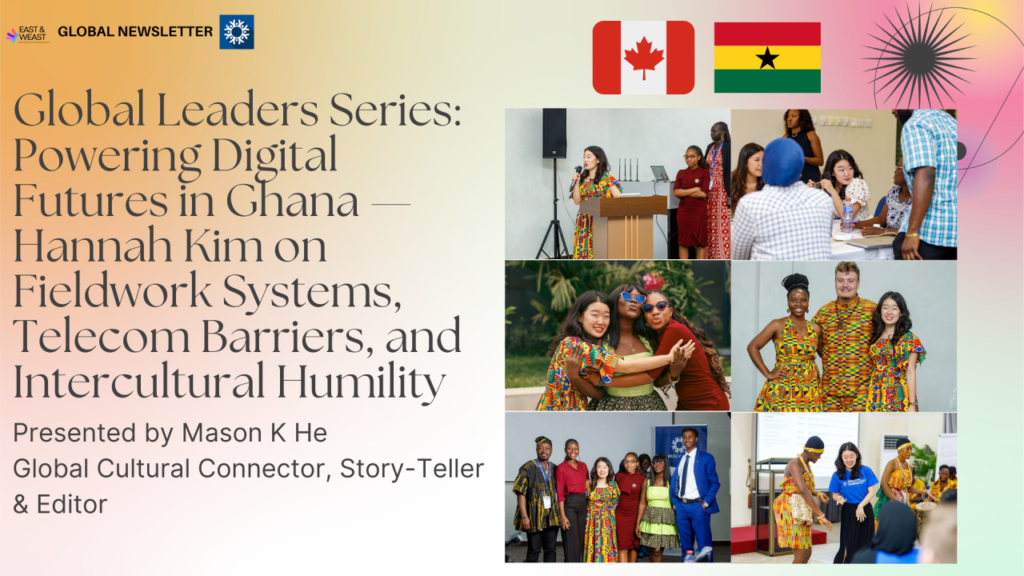
Selected as one of only 12 Canadian delegates for the prestigious 80th World University Service of Canada (WUSC – EUMC) International Seminar, Hannah spent four weeks on the ground in Accra, Ghana. Working alongside Ghanaian co-researchers, local entrepreneurs, and university professors, her team tackled the theme ‘Powering Digital Futures for Young People in Ghana’—analyzing the complex systemic barriers surrounding affordability, digital access, and youth employment.
In this in-depth interview/conversation, Hannah shares her candid reflections on navigating a 10% acceptance rate, conducting ground-level policy research, presenting directly to international diplomats on International Youth Day, and confronting the realities of cultural adaptation as a Korean-Canadian researcher in Accra.
Interview with Hannah Kim
1. The Path to WUSC: Application Rigor & High Competition
Hannah first heard about the WUSC International Seminar through her best friend, where they tend to apply to leadership programs together to develop leadership skills. A past participant had given a presentation at UBC, though WUSC isn’t a widely known organization at University of British Columbia yet. Her friend encouraged her to apply and sent over the link.
“The application required a detailed statement of interest, a résumé highlighting prior research, and concrete examples of technical skills. But the real turning point was the interview. It was a one-hour, high-intensity interview filled with complex situational questions. You had to provide in-depth, concrete examples on the spot—it really tested your ability to articulate your value as a candidate.”
I then asked Hannah if research experience is mandatory, and while Hannah said it is not specified, she stated this year, there were 100 applicants across Canada, and only about 12 students were selected (around a 10% to 12% acceptance rate). While having a research background gives one a definite advantage, they also accept first-year students. Selection committees look at the total package, including your adaptability, leadership potential, and personal intent.
2. Knowledge about Ghana
Hannah didn’t know much about Ghana beforehand beyond a friend who described it as warm and bubbly, plus knowing about Ghanaian chocolate and jollof rice! Hannah naturally craves novelty and adventure, so stepping outside her comfort zone was not an issue at all, and is part of human growth.

On the ground, daily life was vibrant. Food was incredible with variety of options. Hannah recalls having jollof rice, light soup with fufu, and swallow (a sticky dough made from pounded yam and cassava). Ghanaian food is delightfully spicy because locals love pepper, which was perfect for Hannah’s Korean-based taste buds.
“For personal excursions, we relied on ride-hailing apps like Uber or Bolt rather than trotros, which are minibuses converted into public transportation. While safety wasn’t an issue, traveling by trotro can be slower due to heavy traffic, frequent stops, and price negotiations where foreigners are prone to being upcharged. Additionally, unlike North American buses that use automated voice commands for upcoming stops, trotros don’t have that technology and rely on a staff member shouting out the next stop, requiring you to listen carefully. Accra’s street commerce was another fascinating revelation. Vendors skillfully weave between cars at red lights carrying goods on their heads—such as drinks, souvenirs, and sugarcane—allowing drivers to shop directly from their car seats. While weaving through traffic would be considered dangerous in Canada, Ghanaian vendors navigate the streets with impressive tact and timing. You’ll also spot outdoor markets where women sell popular local staples like boiled eggs, plantain chips, and kebabs. Foreigners naturally attract attention, with vendors warmly greeting you in Twi (Akwaaba) while offering their items. Although having multiple vendors approach you simultaneously can feel overwhelming at times, their curiosity stems from a genuine desire to welcome you into their culture, leaving me feeling warmly embraced every single day.”
Negotiating with vendors and the dynamics of shopping are extremely different compared to North America; where I wondered if Hannah felt extremely more cautious to any scams. Hannah acknowledges that as a foreigner and a woman, which adds a layer of complexity, she has to be extra cautious before she buys anything. The seminar program assigned each Canadian delegate candidate a local Ghanaian partner friends during excursions. This was helpful, as the locals are able to know if any of the candidates, including Hannah, are being uncharged or scammed and the friends will try to help negotiate a reasonable price in Twi. However, she recalled an unforgettable experience attempting to visit a fisherman’s market alone without a local Ghanian accompanying her.
“I remember towards my last day in Ghana, I actually went to a fisherman’s village by myself, which is technically not recommended by the seminar as they would tell us to travel with a local Ghanaian friend for safety reasons. No one was available the day I was planning to go, so I decided to go by myself and see the fisherman. I went and somehow got past security with the help of my Uber driver at the gate. They asked if we had a tour guide, and my Uber driver said we didn’t but we will get one when we enter. Inside, I noticed fishermen catching fish in baskets and women peeling off the fish, cooking them and selling them. I later found out that we are not allowed to be there alone as tourists and the supposed security guards approached me and told me that. I was suspicious because they could try to charge me to pay them. I decided to follow them and ask if I had to pay them. They told me I don’t have to pay them, though they were going to arrange a tour guide along with me and I may have to give a donation to them. It all made sense in the end, because they cared about my safety and were legitimate. There could be dangers of me wandering around alone as a foreign tourist and there could be some risks associated with that. Of course, I never willingly just gave money and said yes to everything. It’s also important to ask questions and be realize that as a tourist you will be charged a little bit more. At the same time, I was fine cause I am contributing to their economy (something that is considered a lot there may be considered affordable here), but at the same it equals out having a local Ghanaian friend help you out.”
3. Uncovering Systems-Thinking: The Real Barriers to Digital Access
I noticed that Hannah’s team focused on the “Access” dimension of youth employment and asked what did their fieldwork reveal as the biggest barrier preventing young Ghanaians from joining the digital economy?

Hannah says that there is no ‘single barrier, and it is an interconnected systemic factors rather than a single bottleneck. First, there is a major skills mismatch. Universities teach high-level theory, but students graduate without hands-on, practical execution skills. It’s like reading a manual on how to ride a bike without ever touching one. Unlike Canada, Ghana lacks funded co-op or government-subsidized internship infrastructure, making it difficult for graduates to gain that first crucial layer of experience. Second, networking gatekeeping plays a massive role. Without personal connections, highly qualified youth struggle to secure interviews, highlighting a need for equitable recruitment frameworks. Third, telecom monopolies and data costs. In Canada, market competition keeps plans reasonable, and free public Wi-Fi is everywhere. In Ghana, internet access is dominated by a single major provider. Data costs up to four times more relative to local income levels, forcing young people to strictly ration their internet usage. When accessing the digital world becomes a daily financial burden, developing digital skills becomes an uphill battle, especially for women, rural youth, and individuals with disabilities.
“Before I went to Ghana, I had an idea that many may not have access or be technologically fluent such as not having ability to use excel for example (they may not learn it in school). But they do have programs in place where they learn how to use digital softwares, photoshop from elementary school, and even in middle school, they are given devices to use. So I found the issue isn’t really because of lack of technology access/programs, but more with the administration and how these programs are carried out. There can be a lack of oversight to make sure the youth are using these technologies in a productive way to develop skills. While someone may be given an iPad when they are young, they can just simply go on Tiktok, Youtube, and not use certain softwares effectively. So I think this is something they can work on, possibly adjust the education curriculum in schools, and ensure what technologies are allowed, and tailored in a way that advances their digital pro-ness. Additionally, the cost of data is really expensive. It is at least 4x the amount compared to what we pay here in Canada. We have so many options for providers here in Canada but in Ghana, there is only one main provider that has control of price, so it is easier for them to increase prices. Due to this, many Ghanaians feel like they have to restrict their access to the internet due to increased costs, which is not something we think of here in North America, cause the internet is so accessible especially if you go to places with free public wifi. But in Ghana, it is something you have to pay for in order to access. Also, an interesting thing to note is that there is a huge disparity in equity groups. Women are accessing the internet at lower rates compared to men, and also the same for people with disabilities. Also people who live in rural areas will not have as much internet access compared to bigger cities. So this could affect youth unemployment.”
While the Wi-fi at the hotel she stayed in Ghana during the program was free, she added that the wifi was not good quality, so using data was going to be more efficient. With the wages being lower in Ghana, the data cost is a huge burden and it is continuing to rise. Hannah interviewed locals for her research project and recalled that every single one of them said the data costs are too expensive. In the long run, it will affect them to freely access digital space to develop skills.
“In terms of addressing the market issue, that was definitely out of our scope, especially when you only have one single competitor that is pretty much a monopoly in the market, so it is difficult for us to just say to create more providers. But we definitely recommended the governments to consider asking providers to create subsidized plans for youths or for people in the stage of developing skills to get a discounted plan.”
Something interesting I noted is that youth venture capital is on the rise in Ghana, and it would be interesting to see how the government addresses the main issue of digital access.
Hannah noted while she is glad to hear the rise of start-ups in Ghana, there is still an ongoing barrier of getting those loans or funds approved.
“When you want to start a business, or a venture capital, you need to take a loan out of the bank to get the ball rolling. But that is not easy since you need a form of collateral as proof whether it is property or something that is high in value, and typically you do not have the ability to provide that documentation. Banks are not investing in the youth because it is too high risk. Here in Canada, taking out federal loans is easier, because you can just apply and receive it without much issues. But in Ghana, you simply will have a much difficult time getting enough funds via loans, and having to jump through hoops is almost impossible, so you kinda think how can you effectively start a business with lack of access to a foundation.”
4. Recognizing Inequity & Fieldwork Conversations
In terms of a memorable story that resonated with Hannah:
“I got to meet with an individual who was physically disabled (missing an arm) and discussed with him what were his issues in finding employment because he did go to university and graduate. What was heart breaking to hear was that he went to several rounds of interviews and he was qualified as a candidate. He had the education and experience, skills. The employer simply told him, ‘I don’t think we can hire you because we believe you can’t do the job’. Because he was disabled, so there is a lot of inequity, discrimination that still exists in youth searching for employment, instead of providing accommodations for them being able to work, but instead they are’ shunned’ from opportunities. I would say that was something we saw very significantly as an issue, and another group was focusing on diversity, and differences in gender base groups and differences in rural communities, and the intersection along with those factors. From our conversations, we found that the government prefers certain groups over others, which stuck out to me as there was no even level. In Canada, companies are trying to accommodate as much as possible to encourage more equity and diversity, and there are opportunities for people who need that.”
Hannah also talked to a professor from Accra Technical University and what he thought would be a good concrete implementation to increase youth employment. One of the conversations was centered on providing more apprenticeship programs or internship programs that can provide youth with more skills while in university, because that will close the gap of jumping from university to the workplace. Currently in Ghana, there is only one apprenticeship program nationally, but it is only 1 year and it is limited within a scope, as it mostly offers random assistant jobs, which does not necessarily give youth the real skill. To address this issue, providing more tailored apprenticeship programs to give the youth the skills they need, so something very insightful, which Hannah found talking with the professor.
5. Contributing to long-term systemic change

Hannah believes presenting causal loop diagrams and policy recommendations directly to decision-makers means these insights are now on their desks as they draft future youth employment frameworks. Furthermore, working alongside Ghanaian co-researchers creates a ripple effect as they share these frameworks within their local networks.
“I think the long term impact that our work’s deliverables is what we presented during our policy brief. We laid out our work’s details in youth unemployment, research findings, and concrete solutions or recommendations we have for organizations, businesses, educational institutions, start-ups, etc, and what they could all do to solve this issue. On the last day, I presented at the final ceremony to several stakeholders and government officials on what we can do in terms of reducing unemployment rate, so I am hoping that approach was foredooming and they remembered those details as they received a concrete research debrief proposal and could apply at least some key principles to future policies. For every day impact, the fact that we were all there, presented our work in a seminar along with local Ghanaians, and would tell their network, group of friends, and it could create a ripple effect of gaining understanding through word of mouth and spread these type of solutions and get the people thinking of possibly implementing solutions in any capacity.”
Comparing to Hannah’s home country in Canada, she stated that Canada is also facing a youth unemployment issue. However, Canada has a lot of resources such as co-op programs or internship programs, and even federal student work experience to get one started with training and receive those skills. Compared to Ghana, there is an expected path of one going to university, graduate, and one year of apprenticeship program. Yet, they are not always guaranteed a job afterwards.
“It doesn’t seem like there are other avenues to explore. With start-ups, there is a huge barrier with lack of access to loans/funds. I would say for Ghana, diversify programs, create more opportunities for students. These are so valuable and can be inspired by Canada”
6. Cultural Immersion & Humility

The cultural immersion in Ghana produced some of Hannah’s cherished memories. Every major ceremony featured vibrant drumming and dancing, with performers dressed in traditional Kente cloth. Hannah was invited to join in and was even selected to dance during both the opening and closing ceremonies. The rhythm was enticing, but what stood out most was the genuine warmth and happiness on everyone’s faces, as she remembered it brought so much life and energy to the community’s mission of building a shared future.
“Another highlight was learning basic phrases in Twi, one of the primary languages spoken in Ghana alongside English and other local dialects. On our first day of orientation, a professor gave us a Twi lesson, teaching us phrases like ‘Ete sen?’ (How are you?) and ‘Nya may adom’ or ‘By the grace of God, I am doing good.’ Whenever I spoke basic Twi, my Ghanaian friends’ faces would light up with joy. Even if I stumbled over a word, they would patiently correct me and offer encouragement. Having visited France earlier in January, where, despite speaking French fairly well, I didn’t experience that same reciprocal encouragement unfortunately (this could be due to French’s perspective on Canadian French). I found Ghanaians to be remarkably receptive, warm-hearted, and eager to get to know you. That genuine openness is rare in a world where people often prefer to stay in their own bubble. I also loved the food culture. Eating dishes like fufu or banku is done using your hands, and traditionally, you don’t chew fufu—you swallow it directly. I really struggled at first because chewing is such a subconscious habit, so I had to make a conscious effort to just swallow! Realizing that even something as fundamental as eating food could be so radically different made learning, accepting, and appreciating these cultural nuances an incredibly eye-opening experience
7. Comparing APRU and WUSC
Comparing her participation in both global programs, Hannah highlighted key similarities and structural differences. While both APRU and WUSC required rigorous research proposals and capstone presentations, their execution varied significantly:
- APRU (Shenzhen): A short-term, broad-scope summit uniting Pacific Rim delegates around AI ethics, robotics demonstrations, and conceptual problem-solving. Hannah characterized this as an intellectual exercise focused on bringing lessons back to home communities.
- WUSC (Accra): An intensive, four-week fieldwork project centered on stakeholder interviews, deep data analysis, and direct policy formulation alongside Ghanaian partners.
Because WUSC focused specifically on bilateral collaboration between Canadian and Ghanaian researchers, Hannah found it offered deeper cultural immersion and a more direct path to tangible policy impact in Ghana. Overall, she considers both programs transformative milestones that expanded her global worldview and professional network.
8. On Global Leadership, Risk-Taking, and Cultural Humility
When asked what core qualities emerging student leaders should cultivate to thrive in global programs, Hannah highlights two essential traits: appropriate risk-taking and deep cultural humility. For Hannah, taking risks isn’t about stepping into unsafe situations, but rather embracing the discomfort of feeling unprepared—knowing that leaning into that uncertainty is where long-term personal and professional growth happens. Equally crucial is approaching new environments with an open mind and shedding the assumption that one’s home culture holds the “correct” worldview. She experienced this firsthand in Ghana, where traditional social norms and courtship practices differ significantly from Western dating culture—including being proposed to by several local Ghanian men who were certain of marriage right away. Navigating these stark cultural differences reinforced for her that global leadership requires setting biases aside, listening with genuine curiosity, and recognizing that different societies operate on fundamentally different values.
“You have to realize that being a ‘global leader’ isn’t reserved for a specific type of person. Sometimes people tell me, ‘I want to be like you,’ thinking these opportunities are out of reach. But really, I am just an ordinary student who decided to take the extra steps to travel, apply, and engage in cultural immersion. While people’s starting points and backgrounds vary—especially between developed and developing countries—I truly believe anyone can find these programs and build these skills. You can be a global leader; you just have to foster that mindset and believe it. I used to be like everyone else, watching YouTube videos about how exciting it is to study abroad and explore different cultures. Here I am today simply because I decided to put in the work and step into those spaces.”
9. Intercultural Adaptation: Navigating Identity as an Asian in West Africa
Hannah and I later figured out to include this personal experience navigating Ghana as an Asian/Korean and her story serves as a opportunity for anyone traveling to another country to be prepared for preconceived notions, stereotypes, racism, and how to navigate the challenges of addressing the root of the issue.

Beyond research frameworks and policy briefs, Hannah’s experience as the only Korean delegate in the program provided a profound lesson in navigating identity, stereotyping, and racial dynamics abroad. As an Asian traveler in Ghana—where East Asian visitors are relatively rare and predominantly Chinese—she frequently encountered locals greeting her with “Ni hao.” Having experienced similar comments in Europe with malicious intent, her initial reaction was one of frustration and resentment, viewing the remarks as micro-aggressions.
However, candid conversations with her Ghanaian friends revealed a critical distinction: rather than taunting her, locals associated “Ni hao” as a universal greeting for East Asians and used it out of a genuine desire to welcome her. Recognizing that these comments stemmed from unfamiliarity rather than malice allowed Hannah to process the experience with compassion, let go of resentment, and transform potential friction into constructive intercultural dialogue.
““It’s actually a memorable story – I was at the airport in Ghana getting ready to fly to London and then back to Vancouver when someone at a coffee stand said ‘Ni hao’ to me. I politely told him that I am actually Korean and that ‘Ni hao’ is Chinese. I taught him that ‘Hello’ in Korean is ‘Annyeonghaseyo.’ He repeated the word, learned how to say it, and then asked me to teach him more Korean. That opened the door to a genuine dialogue, allowing him to see that not all Asians are Chinese. Approaching it as an educational learning experience instead of an angry altercation was so healthy. He was very receptive and curious to know more. I am glad I was able to resolve those preconceived notions and stereotypes—it became a true intercultural learning opportunity for me. Also, during the program, there was another Asian delegate who is Taiwanese. Although we look completely different—I am shorter with wavy hair, while she is taller with straight hair, a different complexion, and a different makeup style, locals initially struggled to tell us apart. In our first week, I made an announcement during a seminar to clarify that we were two different people! It’s important to realize that many Ghanaians simply don’t encounter Asian people on a daily basis, so they tend to generalize features out of unfamiliarity. For any Asians traveling to the region, these are helpful realities to keep in mind. In my experience, locals are not malicious—they are genuinely curious and eager to learn more about where you are from and your culture.”
Conclusion & Special Remarks
Reflections on Global Citizenship & Fieldwork Impact

Hannah’s journey through the 80th WUSC International Seminar offers a compelling model for what modern global learning can achieve when approached with rigor, humility, and open-hearted curiosity. From dissecting telecom data monopolies and addressing skills mismatches to presenting actionable policy frameworks directly to the Canadian High Commissioner and Ghanaian Ministry officials, her work demonstrates that youth delegates are not merely passive observers—they are active contributors to international development.
Equally inspiring is her candid reflection on intercultural growth. Whether adjusting to traditional local dining customs, navigating street commerce in Accra, or transforming awkward racial generalizations into moments of educational dialogue, Hannah highlights that true global leadership begins with dismantling personal biases and embracing the unexpected.
As emerging leaders continue to advocate for equitable digital futures across the globe, Hannah’s experience reminds us that stepping outside our comfort zones is where meaningful personal evolution and systemic impact meet.
To learn more about the World University Service of Canada (WUSC) International Seminars, regional youth policy initiatives, and upcoming student research fellowships, visit the official WUSC Portal.