By Mason K He, UC Davis Global Aggie Alumni & Global Storyteller
Featuring Genevie Hong, UC Davis Global Aggie | Cognitive Science & Sustainable Environmental Design Double Major
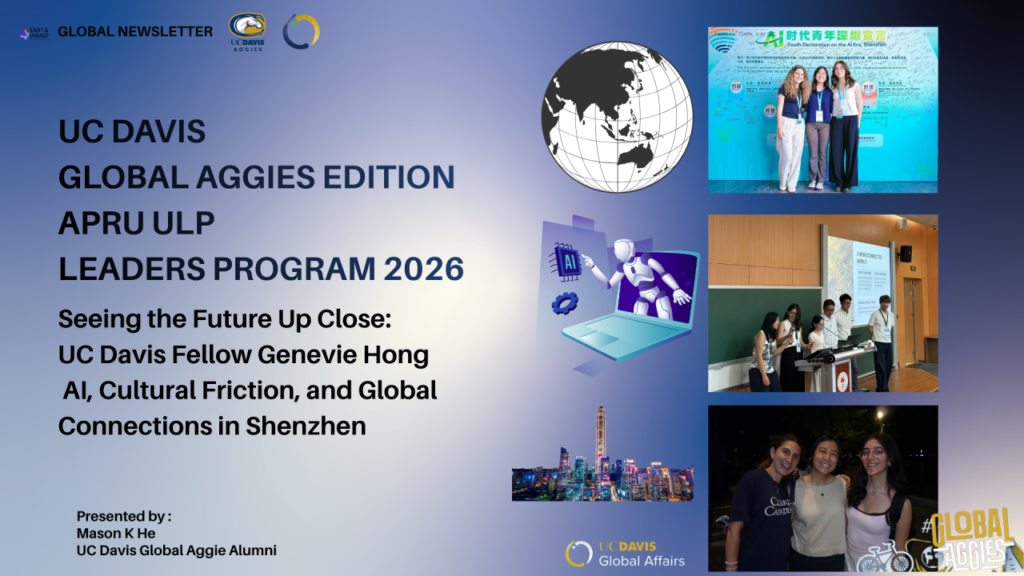
As a UC Davis alumni who has navigated cross-cultural education and global programs across East Asia, I know firsthand the power of stepping out of the Davis bubble into the global arena. In this special edition of our Global Aggies series, I sat down with fellow Aggie Genevie Hong following her return from Shenzhen, China, where she represented University of California, Davis as an Association of Pacific Rim Universities (APRU) Fellow at the 2026 Undergraduate Leaders’ Program (ULP).
Together, we unpacked what happens when an Aggie steps into experiential learning stories abroad and exploring the tension between Western tech skepticism and Eastern tech velocity, the ethics of global AI, and how international experiences shape our identity.
Introduction
When Genevie stepped onto the campus of Southern University of Science and Technology (SUSTech) in Shenzhen, China, she entered a living laboratory of global AI implementation, hyper-technological realities, and ethical grey areas.
Representing UC Davis as an Association of Pacific Rim Universities (APRU) fellow, Genevie Hong, a double major in Cognitive Science and Sustainable Environmental Design, embarked on an immersive dive into Asia’s tech capital. As a UC Davis alumnus, I had the privilege of interviewing Genevie Hong about her experience navigating cultural differences in China between Western tech skepticism and Eastern tech embrace, her honest reflections on the program, and her advice for fellow Aggies.
Interview with Genevie Hong
Before the Application
Genevie first heard about the program through the UC Davis Global Affairs newsletter. She frequently contacts the team at UC Davis Global Affairs for global learning opportunities, but one newsletter post regarding the APRU ULP Program caught her attention specifically because of the focus on AI, ethics, and social context.
“On campus at Davis, students talk about the technical concepts of AI, but we rarely touch base on the social or ethical context. As a Cognitive Science major, I really wanted to dive deeper into that.”
Genevie admitted she actually completed the application just a couple of hours before the deadline because she had other priorities and was figuring out how she wanted to word everything. While it was not difficult for her to answer the questions as she was genuinely interested, framing it professionally and concisely was the hardest part. In her application, she talked about wanting to learn about AI from an Eastern perspective.
“The previous summer in China, I attended a lecture by a film professor educated at UC Berkeley who encouraged us to use AI to make short films. He showed us 20 minutes of full AI videos, something you’d see on Instagram or Facebook. Coming from an entertainment and arts mindset and enthusiast, I remember thinking, ‘how is no one surprised or bothered by this?’ Then I realized; in China, they embrace AI technology in academic settings compared to the West, where students often express strong dislike for AI. Having seen that stark cultural difference, I was able to bring that knowledge into answering the application questions.”
I then followed up to ask her if the nomination process is true and whether she felt the program was competitive to get into (considering other schools usually nominate only a few):
“We had to be nominated. Then they gave us a small stipend and then you have to fill out another application from APRU. It’s hard to say if this program is competitive. A lot of the times when I apply, I feel like I am the only person applying, but UC Davis is such a big school. It’s hard to say.”
Pre-Program Feelings
Genevie recalled feeling very excited though she had only been home for a week the whole summer and had traveled to Asia before. Last year she did a program at HKUST Guangzhou, which gave her insight into what to expect. She even made a friend from Canada who did APRU last year, so they both knew what the program flow would look like. Overall, meeting new people from all over the world is always the most exciting and fulfilling part of the journey.

Experiencing Shenzhen’s tech integration firsthand
Upon arriving and exploring Shenzhen firsthand, Geneive recalled
“There so many robots everywhere, drones air-launch was an option, which you do not see that in a lot of places, robots sweeping the streets. We went to a Seven Eleven(7-11) and there was an option to do palm scanning, so it scans your palm, that was pretty cool. Lots of facial technology, a lot of the time it would scan a face and then the door would be unlocked. Also being at SUStech, there was a lot of technology integrated there such as an elevator; you did not have to click a button as you would just hover it and then it would click for you.”
She and the other participants also learned why Shenzhen is the number one hardware capital in the world. She visited Huaqiangbei, where entire streets are lined with computer technology parts where an engineer who would want to build something could find every part they need and build the prototype on the spot.
“It was interesting to see people from West Asia and Africa visiting markets to buy parts to bring back to their home countries. Shenzhen is still a young city, only about 47 years old as of today, so seeing all these high-rises alongside Special Economic Zone history was fascinating.”
Comparing Shenzhen’s tech scene to California
I was very curious about Genevie’s view on comparing the tech scene between Shenzhen and California, which I felt the honor to ask this question as Genevie thanked me for interviewing her as this was a good opportunity for her to reflect on her experiences.
“I think if this was brought over to the west, it would be embraced. But as a sustainability environmental design major, I realize this would be hard to integrate into the city due to the design and how it would be implemented into the city. For example, San Francisco and Los Angeles, these two cities are very dense and car centric. With too many things going on and adding those (sweeping robots or other AI technological additions) in, it would become so chaotic.”
In terms of walkability, Genevie talked to a lot of students she met in Shenzhen, and many said it felt unwalkable, but compared to any city in California, Shenzhen felt 10 times more walkable. As opposed to whether we could see the same tech integration in California or in the U.S. in general:
“I think it would create more controversy too of how different countries approach security and privacy. You can see yourself being seen caught on camera. There is a camera screen that shows that you are crossing the street. There is lots of transparency in China in terms that you are being watched but we are letting you know you are being watched, whereas in the U.S., you are being watched, but we are not (necessarily) going to tell you.”
Genevie and I continued our conversation on tech integration differences, and she pointed out another example of technological transparency.
“China is very open to letting people know how AI works and what they are implementing and why they are doing this. I can go on but basically to me, in the U.S. there is a lot of gatekeeping. I feel like it is just a prestigious world where people in the Silicon Valley like to ‘gatekeep’ their technological innovations. I feel like that world in the West feels ‘secretive’ whereas in the East, it is more transparent, most likely because of how open China is with their technology. I am not sure about politics behind how AI is regulated, but I would guess they would not have a choice, cause there doesn’t seem to be regulations whereas in the US there seems to be more guidelines.”
Daily Technology Highlights
Although not technically related to AI, one thing that left a strong impression on Genevie was how completely reliant everyone is on WeChat Pay and Alipay.
China is a place where a smartphone is an essential— using transportation, ordering food, or paying bills. In the beginning, Geneive recalled not having an eSIM set up. Due to slow internet access, she had to physically ask a waiter to order food instead of scanning a QR code. These experiences allowed Genevie to reflect on how increased technology makes people more dependent on devices and less dependent on human connection. Genevie avoided having to scan a QR code to order meals, which soon prompted her to make the next action.
“It eventually came to the point where I had to talk to a waiter to order food, instead of scanning a QR code and ordering food. With the increase in technology, it has made more people more dependent on technology but less dependent on people -less human interaction and connection. You’d see groups of friends at lunch, especially guys, all sitting together at a table, but everyone was scrolling on their phones instead of talking. It’s become so common to be an ‘Ipad kid’, in a sense that everyone is looking at their devices even while walking, crossing the street, or riding a scooter.”
ULP Highlights
The highlight was critically examining AI through a wide range of lenses alongside Genevie’s international peers. The program had lectures from industry leaders, and she remembers a company where a CEO presented an idea about robots as a ‘new species tool’ for every room in a household, which made many students puzzled as these innovations are shaped from the Chinese perspective, and even a debate about AI with locals there.

“We had a debate one evening with a lady, who I met at the conference, about the ethics of AI, which was very fulfilling. Confronting those differing global perspectives and asking tough questions made the experience truly engaging.”
I followed up and asked Genevie if she agrees that students had a hard time understanding the Chinese perspective.
“I think it is safer to say due to societal and cultural differences. In Chinese society, there are hundreds of surveillance cameras constantly watching you ,and it is transparent. This country is also safer when going in the subway where there is security and even going to school. They check your school ID before letting you in, which is not something we see at UC Davis or in the US. China is also a country with strong collectivist values so they grew up with different views and mindset regarding what seems ‘normal’ or ‘not normal’ to them.”
Cross-Cultural Group Stories

The students had a group project to complete with other participants and had to come up with an idea and how they were going to present the product to the world. The groups only had a short window (one day) to prepare, and Genevie was actually very sick from an allergic reaction midway through. In the beginning, the group brainstormed and figured out their roles within the team, and eventually Genevie came up with the idea called Holoday, a virtual reality platform designed to bring loved ones along on travel experiences. Holoday aims to solve travel barriers for family members who can’t travel due to age, disability, or visa restrictions by allowing them to experience vacations virtually with you. It touches base of lack of connection and solves that issue by bridging connection even with AI. Upon the unforgettable moments during preparation to presentation day:
“We had some issues with accessibility due to Google being unavailable and sometimes I didn’t feel too comfortable using AI for our presentation slides. I remembered the initial draft of the presentation was built via AI presentation builder (which one of our group members recommended and used) and I wanted to at least having all of those ideas to Canva slides. However, due to my health issues and lack of time, we went in just hoping for the best. Somehow our group won in the end, which to this day, I am still surprised.”

Genevie also talked more in depth of seeing how different groups operate and being able to talk to everyone in the group, and understand how they behave, and while China is very open to AI usage and encouragement, it still felt unusual. Despite that, Genevie highlighted that understanding different global perspectives and how different people approach different things was extremely valuable. She met people all over the world including: Russia, Vietnam, Korea, and others. She also stated that through participating in different activities and hanging out with different people, it was eye-opening, especially with group projects, which she was able to observe how people really behave and work in that setting with cultural behavior aspects.
“I would also say another highlight would be the opportunity to meet people, and how it is a privilege to be with a group of young students within our age group and getting to experience this program during this specific time period/frame, especially in the city of Shenzhen.”
Future Plans
Genevie found the overall experience eye-opening. During the time of the interview, Genevie was in Shanghai for an intensive Chinese language program. She mentioned meeting people from Europe, Africa, and West Asia who traveled to China specifically to learn Mandarin, made her realize how crucial China is in global business, AI, and machine learning. With recent social media trends and the destigmatization how she viewed China growing up, she is now actively looking into international graduate programs and opportunities to work abroad.
“China will basically be the number one country in terms of world economy. If you want to do business and if you wanna make money or have a good job, you have to learn Mandarin. With AI blowing up, China knows that they are competing in AI, machine learning, etc. I also looked into graduate schools and want to learn or work abroad/internationally, but never thought about China, cause there was a stigma about China growing up. In terms of career path, I initially wanted to focus strictly on non-profit organization development. But as I approach graduation, I realize that major investments are flowing into tech, business, and AI. I wonder how can I contribute to society in a role that allows me to be morally good or ethical while balancing finance in my career. This is something I am realizing as I am approaching my final year and graduation soon.”
Tips do you have for the next cohort of Aggie applicants
“Take full advantage of UC Davis’s (and can extend to any university’s) global resources! Again, I realize it is only if you are interested as not everyone is adventurous or global minded. I think this program finds the right people and attracts the right people at the right time. I think more Americans should do this, especially since I was the only American who participated in the program”.
In terms of Genevie’s practical tips for anyone traveling to China or doing a program in China: Set up WeChat and Alipay before you leave, prepare for hot water everywhere in canteens, and if you try bargaining at local markets, remember the walk away method if the price isn’t right so they call you back.
Genevie also had some ambitious and creative topics on what APRU could do next year.
“I know the next APRU program will be in Indonesia. I don’t know if they have the capacity to do this, but it would be cool to do a topic about ethics in tourism, which I find interesting, and the economics involved around that. As someone who has travelled around a bit in Asia, you can see more disparities in wealth incomes of people working to the point where they do not have time to visit their families and are underpaid. For example, while I am visiting here in China, things here are cheap but at what cost? Some people are working 9am-9pm, six days a week, and get paid very little, and I think it will be very complex to talk about. I also think it would be great talk about education in traveling abroad. People who travel to other countries and are not very educated in the local culture, or may be doing things that are rude, or using language that may be disrespectful; this is something I think needs to be talked about more, and should be educated more. Realistically, it will probably be sustainability and environmental. I know they have a sustainable end of year goals program, so we will see what happens next year.”
Favorite food and cultural tips in China
I asked Genevie about her favorite food and any Chinese phrase she would recommend to students. Before mentioning about the canteen food, she tried Dominoes in China, and noted it as an interesting experience to see the Chinese twist on a Western Chain (meat patties on pizzas, etc).
She then proceeded to remembering that she actually enjoyed the breakfast at SUSTech’s canteen, specifically the porridge, different buns and hot soy milk.
“They had everything hot there, which I appreciate now as it is good for the body more. I like the vegetables and the breakfast as it tasted nutritious and not as processed compared to the US. In terms of Chinese purchase, if you want to bargain, you should probably know how to say ‘how much is this’ in Chinese (多少钱 duo shao qian) and learning the bargaining culture. I am very bad at bargaining, because if anyone sweet talks to me, I’ll end up paying for it. All my friends were really good at it. And I wish I waited for my friends to be with me, because I definitely got scammed for a few things. A strategy was basically walking away and they end up calling you back”
Special message for fellow Aggies
“Get out of the country! There is so much more to the world outside the American bubble (I definitely felt it). Going out of the country and truly immersing yourself in another culture, while also meeting people from different backgrounds is a special feeling. Being a student gives you the unique freedom to be curious without high-stakes consequences and to learn directly from global perspectives. I would just stay curious and take advantage of being a student when it comes to travelling, and the most fulfilling learning experience during my time in college has been out of the country and if not, learning from students who are international at my school. “In an increasingly interconnected world shaped by shifting geopolitics, economics, and emerging technology, global progress depends on our ability to collaborate across borders. It is important to start and learn young, because once you graduate, and once you get out of that student bubble, it becomes much harder to actively seek out diverse worldviews with the same openness and curiosity. Engaging with international perspectives early in your academic journey allows you to be aware and address those challenges existing assumptions and shapes your leadership identity. Stepping into an unfamiliar cultural environment forces you to confront differing operational norms and human behaviors. That kind of critical adaptability and experiential learning is something traditional classroom environments simply cannot teach.”
Special Remarks
Following our interview, Genevie and I caught up about our respective journeys and shared goals for community impact. Hailing from Buena Park in Southern California, Genevie’s experiences growing up in a rich Asian American environment ignited her passion for cultural preservation and civic engagement. Today, alongside her studies at Davis, she serves as a lead officer at the Pan-Asian Youth Coalition and an intern with the 1882 Foundation—leading initiatives in Sacramento’s historic Chinatown that bridge understanding between youth and older generations. To learn more about her community leadership and ongoing projects, visit the links below. I encourage everyone to give Genevie lots of love and support for the amount of fantastic work she is doing for the Asian-American & Greater Sacramento community and getting in touch with her Asian heritage side.

- https://aggielife.ucdavis.edu/paycucd/home/
- https://regionalchange.ucdavis.edu/CRC-student-scholars
- https://www.omprakash.org/blog/a-local–yet-global-glimpse-of-the-world
- https://www.panasianyouthcoalition.net/home-2
For fellow UC Davis student/Aggies who may be interested in the next APRU 2027 program, please stay tuned and follow updates here: https://globallearning.ucdavis.edu/pathways/experience/global-leadership/apru-ulp , and you are strongly encouraged to follow APRU’s social media platforms and subscribe to their student newsletter.
I would like to extend my appreciation again to Genevie for being able to participate in this interview and providing an enriching story of her experiences and marvelous advice, encouraging the next group of students to commit to study abroad and global education. As Aggies, we are grateful for our partnership with APRU for making this opportunity possible for her and for all participants.