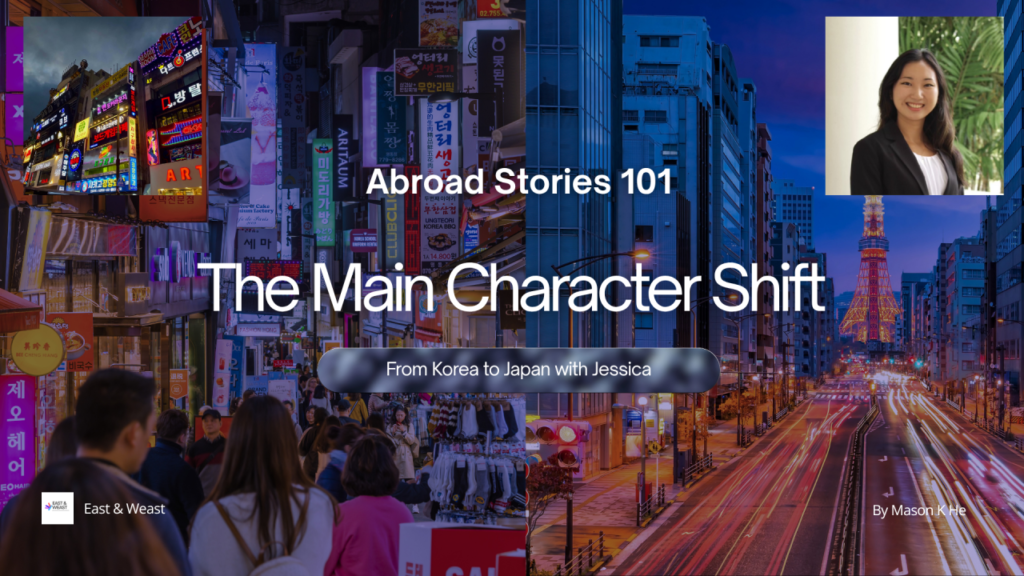
Meet Jessica Matsuda , born and raised in Kaneohe, Hawaii(on the island of Oahu), Jess is a blend of Japanese, Chinese, and Hawaiian heritage. After graduating from the University of Hawaii at Manoa with a triple major in Accounting, Management Information Systems, and International Business, she took the predictable route: auditing at an accounting firm. But today? She’s the Engineering Coordinator at the Halekulani Hotel, a top-tier luxury oasis in Waikiki. A wild, back-to-back study abroad double-feature in South Korea and Japan that completely rewrote her life script.
The Backstory – Inspired to Study Abroad
Jess’s study abroad curiosity sparked in high school. Growing up in Hawaii’s cultural melting pot, deeply influenced by Japanese communities, she was studying Japanese when her sensei dropped a challenge: enter the Japan Wizards Competition (a Japanese trivia contest). The grand prize – a free trip to Japan. Long story short, her team won and she flew to Japan for the first time at 17, an eye-opening experience that left her longing to uncover her own Japanese heritage. Right then, she locked in a manifestation: she would study abroad in Japan once college hit. When she got to UH Manoa, COVID-19 and chaotic scheduling delayed her Japan plans. Instead, her university offered an alternative: South Korea. Aside from watching a few K-dramas with her grandma and casually listening to K-pop here and there, Jess knew next to nothing about Korean history or culture. But after chatting with alumni who raved about living and traveling there, she decided to give it a shot, and she embarked her journey to Yonsei University.
Study Abroad Application Process
Jessica said that her home university, University of Hawaii at Manoa (UH Manoa) has a relatively simple application process. Every student who applies is guaranteed a chance to do an exchange, although depending on the popularity of the program, a student may not get their top pick. As Hawaii is a popular destination for international students, UH Manoa has an extensive variety of partner schools and sends dozens of students abroad every semester.
I asked Jessica if it was logistically challenging, having to deal with back to back study abroad programs (e.g. a Fall program followed by a Spring program) as she studied in Korea and in Japan during her academic semester. She says that back-to-back study abroad programs are usually discouraged. In her case, however, she was given special permission. Her fall semester in Korea would end in December, and since Japan starts its Spring semester in April, she had ample time to apply for her next study visa in Japan.
First Impressions

Landing in South Korea was pure surrealism. For a girl used to tropical environments, lush green mountains, and dense forests, navigating in the big city of Seoul, from Incheon Airport to Sinchon via the subway, felt like stepping into a new world. She noticed,
The Cultural Discovery Shocks:
- The Tech: Everything felt high-tech, dripping in digital signage. In Hawaii, everyone drives or takes the bus. Though she admits the island isn’t the most high-tech compared to other U.S. states or countries.
- The Language: Going in blind, she was pleasantly surprised by the abundant English signage. She had taken a Korean language class at UH Manoa, so she could read the alphabet, but the English signs saved her first few weeks. Plus, she was shocked by how flawlessly many Koreans spoke English in the capital.
- The Eco-Grid: The recycling system was next-level in Jessica’s eyes. Separating vinyl, cans, and plastics was confusing and tedious at first for someone used to throwing everything into one single trash can or recycling bin back in the U.S.
- The Weather: Snow – Jess had literally never seen snow until late November 2022 in Sinchon. She had never felt that cold in her life and was stunned by how fast temperatures plummeted.
- The Uniform: Coming from a warm climate where bright, casual clothing rules, Jess stepped onto the subway in her vibrant gear only to find a sea of ultra-fashionable locals rocking sharp blacks, whites, and only subtle hints of color (like red or blue). Everyone had flawless skin and hair, and K-pop blasted from every street corner and restaurant.
Overall, she felt Seoul was lively and “futuristic” especially for someone who grew up on an island, which was what she expected. She also a noted a memorable digital culture shock moment.
“As silly as it sounds, my friends and I from Hawaii struggled to figure out how to open the door to Paris Baguette on our first day because we didn’t know we had to press the digital door lock and were instead looking for a handle! We ended up just leaving. Now, it’s common sense!”
Campus Life & Curriculum
Part 1: The Yonsei Era
Student life at Yonsei was fantastic from Jessica, majorly thanks to its prime location in the heart of Seoul, surrounded by an endless loop of cafes, restaurants, arcades, and nightlife. Jess found her community instantly by mingling in her classes and her goshiwon (a tiny student housing setup just minutes from campus). Suddenly, she had an international squad of exchange students to explore the city with daily. They bonded over unlimited arcade games at La Luz, target shooting at the Robinhood archery cafe, and late-night bingsu runs to Sulbing. While she wishes she had made more local Korean friends, she noticed that Korean students who already spoke English or had studied abroad in English-speaking countries were the most inclined to approach and befriend her.

Part 2: The Waseda Shift
Next, Jess headed to Tokyo for a semester at Waseda University . For her, it was less of a culture shock given Japan’s massive cultural footprint in Hawaii, but Tokyo’s sheer scale of its metropolitan city status required serious adjustment. The rush-hour crowds at train stations were unlike anything on the islands (Hawaii gets crowded, but it doesn’t compare to the Tokyo hustle).
Other micro-shocks? The total lack of public trash cans meant she had to carry her garbage around all day. Walking strictly on the left side of the sidewalk, standing on one side of the escalator to let others pass, and placing yen into a little tray at convenience stores instead of handing it to the cashier.
On the plus side, she was surprised by the abundance of solo-dining options. In Hawaii’s ohana-centric culture, eating alone is rare since group dining is highly valued.
The Academic Climate Difference
My home university courses were definitely more intense, but it’s likely because the courses she took in Korea and Japan were tailored to international students and were taught in English. When discussing with professors in both Japan and Korea, she was told that the classes tended to be easier and have lighter loads because they knew international students were there enjoy their experiences and avoid having classes take up too much of their time. However, this is dependent on the course as she had friends who enrolled in more intense courses that were harder than any class back home.
Another professor in Japan told me they purposely made the class easier (it was taught in English) because we had many Japanese-speaking students who were there to learn English by speaking with us international students and taking the course entirely in English. It was moreso of a learning opportunity for the Japanese students.
She also felt that Yonsei’s courses, particularly the history classes and culture classes, was the academic learning standout, as it placed emphasis on the Japanese occupation and war crimes, which she was ashamedly unaware of.
It opened my eyes to the horrors that occurred just a century ago. I developed a much deeper understanding and appreciation for Korea and its history. On a lighter note, I took a Korean pop culture class at Yonsei, and the professor would play k-pop music videos and scenes from k-dramas in class. She introduced us to some classics that I still listen to to this day!
THE ULTIMATE VERDICT: KOREA OR JAPAN?
If forced to choose, Jess splits the crown. For student life and community, Korea wins hands down—she preferred Yonsei’s location, the chaotic mix of activities, the cafes, and the friendships.

But for pure travel, Japan took the prize. Waseda ran on a two-quarter system rather than one long semester. Jess systematically stacked her few classes on Mondays during her first quarter, leaving the rest of the week completely open to jet-set across different prefectures, hit up traditional festivals, visit shrines and villages, and hunt down regional food specialties.
REVERSE SHOCK & THE ACCOUNTING ESCAPE
After a whole academic year of exchanging abroad, Jessica admitted that she experienced heavy reverse culture shock technology-wise upon her return to Hawaii. It felt like taking a step backward. She deeply missed the bidets she grew to love abroad, and the lack of digital self-ordering kiosks at fast-food joints felt archaic. Throwing all her trash into one bin without sorting it, which is the norm in Asia, felt entirely wrong. Plus, transitioning from a freezing Seoul winter straight back into tropical Hawaiian heat was a total system shock.
But the internal shift was even bigger. Jess found herself confident, highly social, and fiercely independent. While at Yonsei, she threw herself into a taekwondo class, training under a master for two hours a day, three times a week alongside other international students. It left her physically stronger, more flexible, active, and self-assured.As for if she were to do anything different?

“I would have traveled more in Korea, as well as made more of an effort to immerse myself in the Korean culture by befriending more Korean friends, as I naturally gravitated toward the international students in my program. I didn’t have much of a chance to see the countryside, which I’ve heard is better for experiencing traditional culture. However, I have no regrets about the decisions and friends I’ve made. I also wished I packed less when I went to Korea. I didn’t realize how much shopping I’d do because the clothing is so fashionable and cute, not to mention affordable!”
Impact on her academic and professional career
Initially, Jessica’s main career path was accounting, so when she got back from studying abroad, she went straight back into studying accounting and working for an accounting firm. However, studying abroad had made her more curious and interested in pursuing a career that dealt more with international relations and travel. The tourism and hospitality industry in Hawaii is strong, she notes. She ended up pivoting towards a career in hospitality just a month ago, and have loved her job ever since. Studying abroad has made her more adventurous and encouraged her to take more risks, motivating me to steer off her path of becoming an accountant and pursue her passion!
“To anyone thinking of studying abroad, meet as many people as you can, experience as many things as you can, and don’t be afraid to say “yes” when the opportunity arises. If you’re feeling lazy but a classmate invites you out to dinner, take that chance to make memories by saying yes! Remember that you will possibly never get the chance to have this amount of freedom to travel and enjoy your youth ever again, so don’t be afraid to take risks and step outside your comfort zone.”
WHAT’S NEXT?
Currently working full-time in Hawaii, Jessica plans to continue her work and hopes to become a hotel director. Because her current luxury hotel is owned by a Japanese company, there are direct opportunities for work exchanges with sister hotels in Japan.
What did you think of Jessica’s experience? Did you resonate with any of her experience? Please let us know in the comments and we hope you enjoyed today’s Abroad stories 101 edition.
Best,
Mason
East & Weast