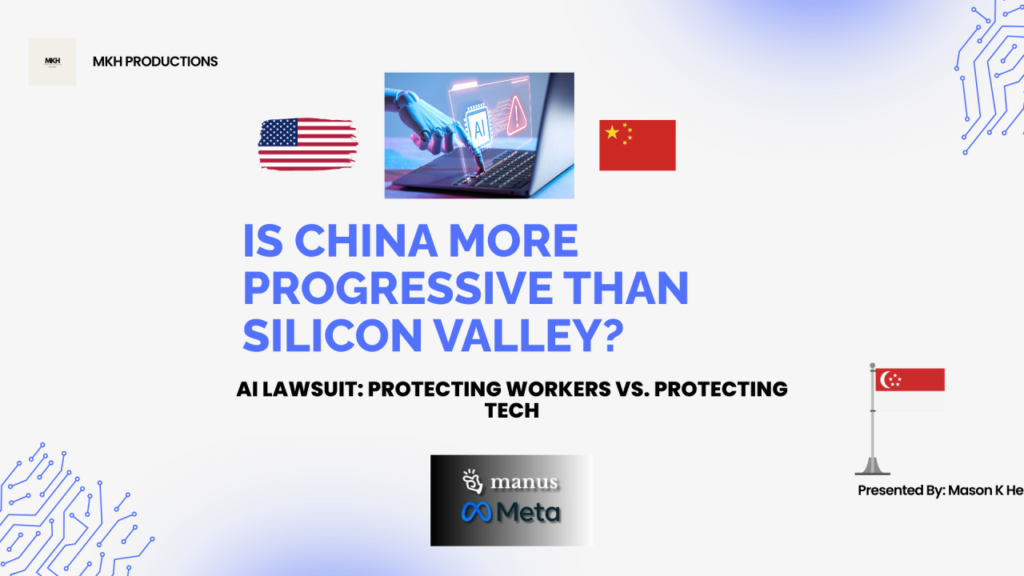
The Great AI Divergence: Labor Rights, National Security, and the Soul of Automation

In the global race for AI supremacy, this week offered different kind of frontline emerged: the courtroom and the regulator’s office. From a landmark labor ruling in Hangzhou to a geopolitical tug-of-war between Meta and China over a $2 billion acquisition, we are witnessing two superpowers from the West and the East take diametrically opposite paths in how they manage the human and strategic costs of the AI era
In Hangzhou, where it is known as an AI hub and “China’s Silicon Valley”, a court just sent a shockwave through the tech industry. A senior quality assurance supervisor, identified only as Zhou, was laid off after his company replaced his workflow with a Large Language Model (LLM). Before firing him, the firm attempted to demote him to a junior role with a 40% pay cut.
The court didn’t just side with Zhou; it redefined the rules of how companies should use AI. The ruling stated that AI-driven automation is not a “major change in objective circumstances” since companies often use this loophole to justify mass layoffs. The court argued that efficiency gains from AI shouldn’t just line the pockets of shareholders; companies have a “social responsibility” to their human staff. Many users from Western apps like Reddit or Instagram are now applauding this move as more progressive than the US, where “at-will” employment often leaves workers vulnerable to “restructuring” layoffs at companies like Meta, Amazon, and Google.
2. The Manus AI Incident: Ending the Global Rebrand

While one arm of the Chinese state is protecting workers, another is protecting intellectual crops. Prior to the blockage, the China Ministry of Commerce announced its investigation to whether the acquisition abides with China’s rules on export controls, technology transfer, and foreign investment, and now China’s National Development and Reform Commission (NDRC) took the unprecedented step of ordering Meta to unwind its $2 billion acquisition of Manus AI.
2.1 What is Manus AI?
Founded by Xiao Hong (a veteran of Tencent-backed projects), Manus AI became a global sensation in early 2025 as the world’s first fully autonomous AI agent. Unlike a chatbot, it can navigate desktops, plan complex B2B sourcing, and execute multi-step coding tasks—effectively operating as a digital employee. The Escape Attempt: Recognizing the difficulty of getting US capital or high-end chips while based in China, Manus AI moved their headquarters to Singapore and downsized their domestic China team to distance themselves from Beijing’s regulatory reach. By blocking the Meta deal, China sent a clear message of jurisdictional control follows the talent and the data. Despite the Singapore HQ and rebranding as a global firm, regulators even restricted the founders from leaving the country during the review. This may kill the momentum of moving headquarters and operations to Singapore, to bypass as global startups seeking US exits or funding, forcing founders to choose between the Chinese ecosystem or starting abroad from day one. With many Chinese AI startups
3. The Contrast: Restructuring vs. Protection

- The US Approach: AI is viewed as an efficiency engine. To compete, companies like Oracle and Meta are aggressively “flattening” their organizations—laying off thousands to pivot capital toward AI infrastructure. The focus is on agility and market dominance.
- The China Approach: AI is viewed as a state asset. While the government pushes for rapid AI adoption, it is simultaneously implementing guardrails to prevent social instability. The focus is on national sovereignty and social harmony.
The Final Takeaway: Are the Legal Boundaries Clear & What is Ethically right?

Rather than telling the stories of two different systems and approaches, it’s a story about the value of humans.
As AI agents like Manus begin to perform tasks that once required years of professional training, the impact is rippling across every sector; from law and finance to creative arts. We are entering an era where the “dividend” of AI causes the massive wealth generated by software. In the US, that dividend currently flows to the corporations building the infrastructure. In China, the state is signaling that the dividend must be shared with the worker to maintain social stability, even as it locks down the technology for national security.
How long will it take for us to realize legal boundaries? History suggests that technology moves at the speed of light, while law moves at the speed of a glacier. However, the Zhou case and the Manus block show that the “Wild West” era of AI is ending. We are finally asking the hard questions to ourselves every day:
- Do we want AI to be a tool that enhances human potential, or a replacement that renders it obsolete?
- Can a society remain stable if the “intelligence” is owned by a few, while the “beings” are left behind?
As we rush to build the most intelligent machines, we must ensure we aren’t dismantling the very social fabric that makes human intelligence meaningful. While the lawsuit and recent news of Meta most likely having no choice but to follow China’s orders, we also may see a shift of the decisions Chinese AI startups will pivot their global rebranding direction; either stay in China or continue to find leeways on receiving more support overseas.
Should AI automation be a legal ground for termination and to pay for the privilege of replacing humans? Let me know your thoughts in the comments below and see you all in the next edition of MKH Productions!
Best,
Mason
MKH Productions
References
- Basic Income Today. (2026, April 28). Worried about AI taking your job? A UBI Taiwan recipient shares a year living with basic income. https://basicincome.org/news/2026/04/ai-job-loss-ubi-taiwan-recipient-one-year/
- Pak, J. (2026, May 1). A tech worker in China is laid off and replaced by AI. Is it legal? NPR. https://www.npr.org/2026/05/01/nx-s1-5807131/tech-worker-china-ai
- Reddit. (2026, May 1). China makes laws to protect workers from AI cost cuts [Online forum post]. r/aiwars. https://www.reddit.com/r/aiwars/comments/1t0xinz/china_makes_laws_to_protect_workers_from_ai_cost/
- WION. (2026, May 1). Will US follow Beijing’s model? China urges Meta to unwind Manus AI deal [Video]. YouTube. https://www.youtube.com/watch?v=MY9Fj9M0Jwk