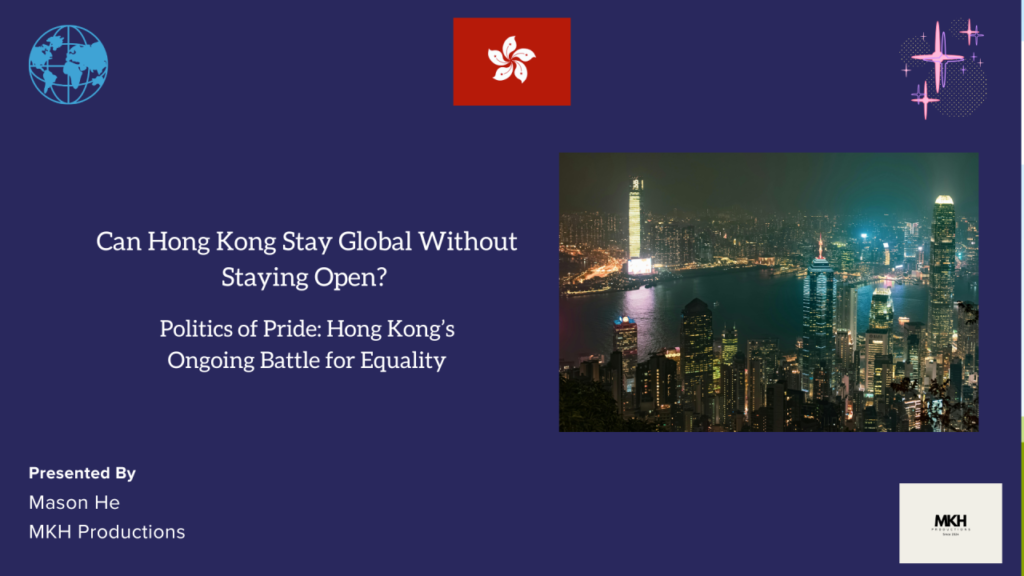
Hello everyone! Happy November!
In this edition of MKH Productions, I would like to shed some light to the LGBTQIA+ community in Hong Kong, a city once(and still) recognized for its international outlook and progressive image. And also, how do local communities and events such as Pink Dot Hong Kong continue to champion equality and visibility amidst political challenges? As we start to see Hong Kong encouraging more talents to work or do business, what does this mean for the upcoming talent’s expectations?
The State of LGBTQIA+ Rights in Hong Kong

In September 2025, Hong Kong’s Legislative Council voted on the Registration of Same-sex Partnerships Bill, which sought to provide limited legal recognition for same-sex couples, particularly those whose partnerships had been registered overseas. The proposal aimed to extend certain rights; such as hospital visitation, medical decision-making, and inheritance arrangements, but fell short of full marriage equality.
The bill was defeated by a wide margin, with 14 legislators voting in favor and 71 against, and one abstention. The outcome made headlines across online communities, as it marked the first time since Hong Kong’s electoral overhaul that lawmakers rejected a government-backed proposal. The administration of Chief Executive, John Lee, had presented the bill to comply with a 2023 Court of Final Appeal ruling that required the government to create a legal framework for same-sex relationships within two years. Legislators who opposed the measure, arguing it would undermine “traditional family values” and cause unnecessary “social division.” Their stance highlighted how deeply cultural and moral concerns continue to shape policymaking in Hong Kong.
For LGBTQIA+ advocates, the vote represented a major disappointment. Many had seen the bill as a symbolic first step. Although not a comprehensive solution and had its flaws, it was a step further to acknowledge that equality between same sex couples deserves legal recognition. Its rejection underscores the widening gap between Hong Kong’s legal system and the evolving social attitudes of its people. Recent surveys suggest that public sentiment is shifting toward greater acceptance. A 2023 study by the Chinese University of Hong Kong found that around 60% of respondents now support same-sex marriage, compared to just 38% ten years earlier. This change reflects the growing influence of younger generations who are more connected to global values and diversity.
From an international perspective, the failure of the bill raises questions about Hong Kong’s long-term global competitiveness and inclusivity. Analysts warn that restricting social progress may make it harder for the city to attract and retain foreign talent — a key element of its success as an international business and financial hub. In a world where inclusivity increasingly defines modern urban identity, Hong Kong risks falling behind other global cities that are embracing equality as part of their growth narrative. This would also be something to consider especially since more global firms have left Hong Kong, and was the number of global companies decreased by 13.3% between 2019 and 2023 according to Census and Statistics Department data.
According to recent coverage by CNN, insiders and analysts warn that such further political regression could damage Hong Kong’s international reputation and undermine its ability to attract global talent, especially as diversity and inclusion become defining values for modern cities and workplaces.
Community Resilience: Pink Dot Hong Kong

Despite these challenges, Hong Kong’s LGBTQIA+ community continues to show remarkable resilience and creativity. One of the most visible symbols of that resilience is Pink Dot Hong Kong, an annual event inspired by Singapore’s Pink Dot movement, which celebrates love, equality, and diversity. In recent years, Pink Dot HK continued to face more political and social pressure from hosting events and as there are government funding cuts for sexual minority NGOs, global corporate companies in HK with DEI frameworks are continuing their full support for Pink Dot. You can see pink Dot’s story and sponsors here.

Each year, Pink Dot gathers thousands of supporters, LGBTQIA+ individuals, allies, and organizations; to create a sea of pink in support of inclusion. It is both a celebration and a protest, a space where people can safely express their identities and advocate for a fairer future. You can check out this year’s live-streaming event here.
However, this year’s Pink Dot faced more unexpected challenges. Due to a series of venue and vendor withdrawals, reportedly tied to rising social and political pressures, the organizers were forced to cancel the usual outdoor fair and instead host an in-person concert to keep the spirit of the event alive. Despite these hurdles, the event still drew passionate participation and served as a reminder of how the fight for visibility and acceptance continues.
Looking Ahead

The future of LGBTQIA+ rights in Hong Kong remains uncertain. While the government continues to resist formal recognition of same-sex unions, public attitudes — particularly among younger generations — are gradually shifting toward greater acceptance. Community events, advocacy groups, and digital campaigns remain vital in shaping public discourse and sustaining visibility for equality. Economically, Hong Kong continues to leverage its free-market economy, low tax regime, and strategic access to the Greater China market, making it an attractive base for multinational companies. At the same time, China has reiterated its full support for Hong Kong’s position as an international financial center. During the 2025 Global Financial Leaders’ Investment Summit, Vice-Premier He Lifeng reaffirmed Beijing’s confidence in Hong Kong’s prosperity, emphasizing the city’s integral role in global financial governance and long-term stability.
“The Party Central Committee’s proposal for the 15th Five-Year Plan has made important arrangements to support Hong Kong’s development, outlining a brighter future for the city,” He stated in his opening keynote address.
However, as China pledges continued economic backing, an important question remains: how can Hong Kong sustain its global competitiveness without stifling the diversity and openness that once defined it? To attract and retain international talent, the city must balance political alignment with inclusivity, ensuring that progressive values: including equality for the LGBTQIA+ community — are not sidelined.
Ultimately, Hong Kong’s identity as a global city depends not only on its financial prowess but also on its commitment to diversity, freedom, and human rights. As the city navigates its evolving political landscape, the voices of its LGBTQIA+ community — along with allies who continue to stand beside them will remain essential in defining what kind of future Hong Kong chooses to embrace.
That’s all for now for this edition. Please let me know your thoughts on this matter in the comments. See you in the next edition!
Best,
Mason
MKH Productions