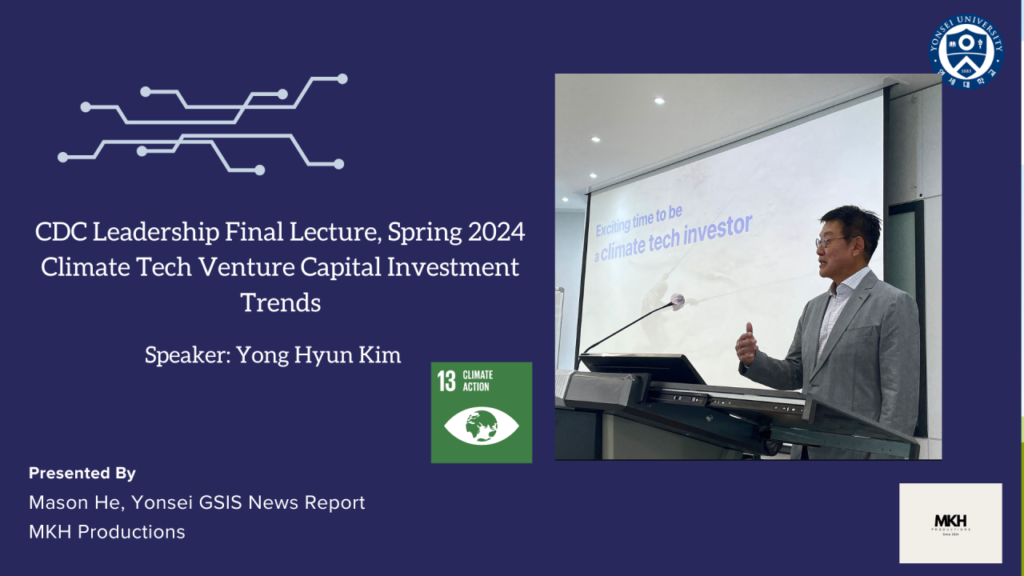
At Yonsei GSIS , Yonsei GSIS Career Development Center , also known as CDC, arranges leadership lectures every semester and it is also a resource for students to look for job postings, receive individual consultations, mock interview practices, and mentoring programs with professionals in Korea with Professor Namuh Rhee . We are honored to have met the speaker Yong Hyun Kim , the final speaker of the CDC Leadership lecture this semester.

At the recent CDC Event on June 4, Yonghyun Kim from Envisioning Partners delivered a comprehensive overview of current trends in climate tech venture capital investment. Kim highlighted the firm’s focus on climate investments in the US and Asia, emphasizing their leading role in impact investing in Korea. He described impact investing as the most proactive form of sustainable investing, which requires unique approaches depending on the investor—be it public entities, private equity, or venture capital. ESG screenings are crucial in evaluating companies’ environmental, social, and governance factors, directly influencing investment decisions. Kim noted that the private market allows investors to stay ahead of major market opportunities, particularly as climate change’s global scale increases market potential.
Several factors drive the continued momentum in climate action, including shifting customer perceptions, stricter global climate regulations, and transformative policies. Leading US firms and investors, such as TPG Rise Climate, are establishing funds to support climate tech initiatives. Collaborative ventures like Decarbonization Partners, a joint effort between BlackRock and Temasek, highlight the global commitment to decarbonization. Notable figures like Bill Gates and companies like Amazon are also forming ESG-focused funds.
Over the past three years, there has been significant growth in the number and size of climate tech venture funds. Global climate tech investments have surged over the last seven to eight years, although the capital market contraction poses challenges to funding flows. Understanding asset owners’ fund allocation strategies and startup performance is essential for navigating these waters.

Recent moves by financial institutions, such as BlackRock’s acquisition of Kreos Capital, demonstrate the industry’s focus on climate change. Collaborative efforts with established industry players are vital, as seen in partnerships with major companies like United Airlines and Allbirds. The COP28 agreement on energy transition further underscores the need for a collective approach to phasing out fossil fuels.
Investing in climate tech requires a nuanced approach, emphasizing connections with incumbent players and a deep understanding of global supply chains. Both equity and non-equity financing options are vital, and global collaboration is crucial, especially as Asia (excluding China) still lags in climate tech investments. South Korea, however, is making strides with plans to support the K-Taxonomy for climate tech.
Conclusion
He concluded by stressing the importance of a long-term climate action strategy, developing expertise and networks, building supportive ecosystems, and including transition financing. He encouraged aspiring climate tech investors to pursue careers in this exciting and impactful field, highlighting the need for a global perspective and collaboration among government agencies, industry players, and talent pools.

Thank you once again to Yong Hyun Kim for the presentation and some outlook on the trends in the climate tech venture industry. Additionally, I would like to extend my appreciation to Namuh Rhee and the CDC Assistants for arranging these great career talks for the students at Yonsei GSIS .
To keep updated with CDC, you can follow their Instagram @yonseigsis_cdc .
The End
Mason He, Yonsei GSIS, News Reporter
MKH Productions