Beginnings & Pivots

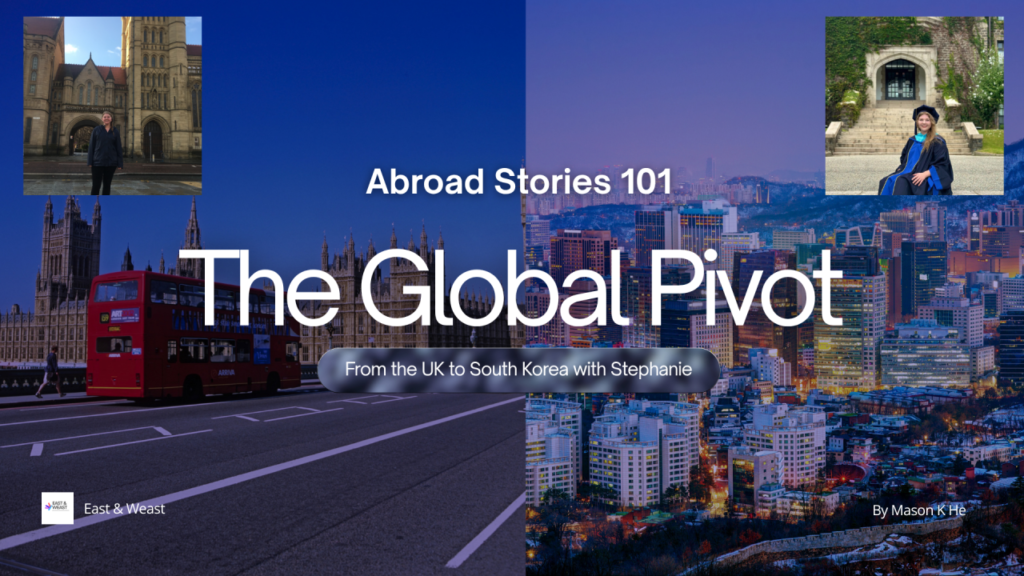
Stephanie’s journey wasn’t a straight, smooth line; it was a series of pivots, from the charm of the UK to the high-stakes academic culture of South Korea.
For many, study abroad starts and ends as a single semester of exploration. For Stephanie, it was the catalyst for curiosity and a total life redesign. Her international trajectory began in a high school auditorium, where she was listening to a speaker and inspired her to put study abroad on her bucket list when she began her undergraduate studies. She recalls debating between the UK and Cyprus for her program.
“I was a bit more reserved with location choices,” she admits, reflecting on her first foray with the University of California Education Abroad Program (UCEAP). “I had never been outside of the US, nor had I done much research.” Following a friend’s lead, she landed in Manchester, a move that broadened her horizons and ignited a lifelong love for global education.
Realizing the Dream Path


While Manchester provided the foundational first step, she realized how much she loved traveling and living abroad. She wanted to experience a study abroad program in a completely different country for the next program. As Stephanie gained an interest in Korean culture and geopolitics, she decided on South Korea for UCEAP Spring 2020 program. Unfortunately not too long after her arrival, the program suspended due to restrictions in travel to control the virus from spreading further. But Stephanie’s ten-day stint in Korea in February 2020 realigned her entire compass. She says,
“I wanted to experience a study abroad program in a completely different country. I had gained an interest in Korean culture and geopolitics… and those 10 days spent in Korea changed my life. I loved it so much that I returned through the Global Korea Scholarship program two years later.”
As a Global Korea Scholarship (GKS) recipient for a Master’s at Yonsei University Yonsei GSIS , Stephanie found the academic transition to be a study in contrasts. In Manchester, she was immersed in a predominantly British cohort, feeling a distinct “academic culture shock” that felt more foreign than the US system. Conversely, at Yonsei’s Graduate School of International Studies (GSIS), the academic atmosphere mirrored Western academics more closely, though the “relative grading” system remained a hurdle.
She studied international politics and admitted that she had the privilege of taking courses related to the region she visited. While she was unable to pinpoint what was different about UK’s academic culture, she felt that being surrounded by UK-based students allowed her to sense the difference, whereas in Korea, she was with international students and the overall format matched her experience back in the US. For Stephanie, the personal growth was just as rigorous as the academics.
“My time in Korea offered more opportunities for personal growth. I strengthened my problem-solving skills whilst overcoming language and cultural barriers and creating a new life abroad.”
Cracking the GKS Code
The road back to Seoul was a lesson in persistence. After her 2020 UCEAP program fell through due to the pandemic, Stephanie attempted to find full-time work in the US. When that didn’t pan out, she spent six months researching ways to return to Korea. While she considered teaching programs like EPIK, the GKS Embassy Track felt more aligned with her long-term goals. She applied to Yonsei, Ewha Womans University, and Pusan National University—and was accepted into all three.

Applying for the GKS is notorious for its bureaucratic weight, but Stephanie’s approach was simple: Prepare early and make it personal.
- Start Early: Prepare early. Starting when the official application opens will make things quite stressful. Reach out for letters of recommendation and locate personal identification documents for your family months in advance.
- Find your Narrative: Although Stephanie, and other recipients, are hesitant to share personal statement advice, she insists that your story and purpose is the key. “Don’t just follow the standard advice floating around the internet. Think about why you want to study in Korea, why the GKS is a fit for you, and why you are a fit for the program.”
The Cultural Deep Dive
Living in Korea for three years offered a level of immersion that a semester simply not many have. As a GKS scholar, she began with mandatory language school outside of Seoul before she started her master’s program.

“It was definitely fast-paced, but I came to quite like learning Korean. The benefit is being able to use the language on a daily basis. Every time you pick up a new phrase, you can turn around and apply it to your daily conversation.”
However, she navigated significant nuances, specifically the indirect communication style where a “no” is often softened to “I think that will be difficult.” Stephanie is also refreshingly candid about the struggle of language acquisition: “I found the ‘write, read, then memorize’ method ineffective for speaking. Despite strong reading and listening skills, I’m still working on becoming a better speaker. Everyone learns differently.”
The Transition to the Big City
Moving from language school to a Master’s program at Yonsei brought another shift as she was navigating finding new friends and connections in the big city. While her courses were in English, her Korean skills were vital for surviving in scenarios that required that.

“For the first time, I was living in Seoul and surrounded by people pursuing a similar academic path as me. At the same time, it was incredibly difficult splitting up from the friends I had made in my language program. We had all bonded so strongly there, and really spent a lot of time together in close quarters. Going from dorm life to living in an off-campus apartment was both exciting and, at times, lonely.”
How about academics between Yonsei and the US? Stephanie says she didn’t feel too much of a difference between the academic system at Yonsei’s Graduate School of International Studies (GSIS) versus that of the US. She recognizes the reason is that the program is taught in English and is aware many of the professors have studied or spent time in the US. However as an international student in Korea, she struggled a bit with understanding the relative grading system.
The Vision: Total Immersion

When asked what kind of program she would create and lead for students today, Stephanie’s theme is singular: Immersion. She envisions a “Dream Curriculum” that moves students out of the classroom and into the “trenches” of the culture:
- Academic: Interactive workshops on North Korea featuring day trips to the DMZ and direct conversations with defectors.
- Culture: Bibimbap-making in Jeonju, wearing Hanbok at the palaces, and watching the Haenyeo women divers in Jeju.
- Professional: Leveraging personal networks and showing that a career abroad is built on flexibility.
On one final note, she also would consider adding Korean calligraphy classes and the Kimchi-making experience at Seoul’s Museum Kimchikan. For those seeking activities related more to Seoul city life, events focused on city photography or outings dedicated to getting to know certain Seoul districts could also be plausible.
“Overall, I think immersion is such an important part of a study abroad experience. What most students seek when they choose to live in another country for any amount of time is the chance to experience a new culture and way of life. For example, as a student, I had the privilege of participating in workshops on North Korea that involved day trips to the DMZ, conversations with defectors, and so on. I think these sorts of academic experiences are so important and can really help to immerse students in the content that they are studying. Rather than looking in from the outside, these kinds of programs can help students make the most of their study abroad experiences.”
Final Advice & Conclusion

Stephanie recognizes the “Hallyu Boom” is bringing more international students to Korea than ever. Her advice? Evaluate how you want to utilize the experience. Ask yourself:
- Do you want to build a career in Korea?
- Do you want to travel and explore?
- Do you want to immerse yourself in the day-to-day work or study culture?
Stephanie then highly recommends students to get out, explore, and participate in university events and spend time getting to know their campus. In terms of how the program taught her upon completion.
“I knew prior to applying to GKS that I wanted to further my studies into Korean politics and East Asian international relations. I also knew that I wanted to travel and learn more about Korean culture and history. That said, I think that because the program duration was 3 years, I had a bad habit of putting things off. Whether waiting until I had more money, waiting until I had more energy, or waiting until I had a friend with me to join me, for the first half of my time in Korea, I continuously put things off. Eventually, I realized my time in the program was coming to an end, and I needed to do the things that I wanted to do. This is something I am also applying to my life here in the United States.”
The most important lesson Stephanie would give to anyone who wants to either study, live, or work abroad?
“Your path does not have to be linear. Many of my friends are struggling to find work, both in Korea and abroad. It’s okay to work in something unrelated to what you want to do. In the end, it’s incredibly impressive to work in another country, and these skills will transfer.”

“Life is too short to keep putting everything off,” Stephanie reflects on her final note. Whether it’s navigating relative grading at Yonsei or finally doing the things you always wanted to achieve abrad, her journey proves that the best way to understand the world isn’t to watch it from afar, but to simply decide to be in it. The lesson is to think hard of your purpose, how you want to utilize the experience to your personal, academic, professional, or any type of growth. Most importantly, the paths we initially thought or planned from the start go through challenges in the middle, so stay open to changes and be open to adaptability.
Whether you’re eyeing a short-term immersion program or a long-term professional move to East Asia, the message is clear: there will be multiple hurdles in your path, but the growth is absolute. If you’re waiting to study abroad soon, consider these tips. Are you thinking studying abroad soon but found this article in helping you decide? Please let us know in the comments
See you all in the next edition of Abroad Stories 101 this Thursday!
Best,
Mason
East & Weast