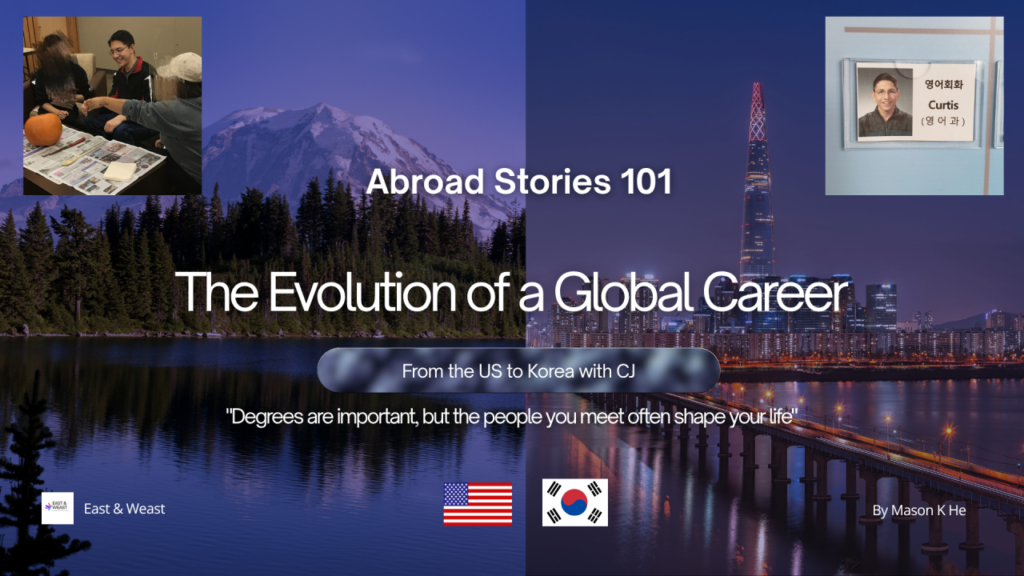
While most people treat an English teaching in Asia like a two year gap, my friend from Yonsei, Curtis Carney aka CJ, turned it into a masterclass in global living. Eight years, two cities, and one Yonsei Master’s degree later, he’s sharing how he ended up scriptwriting for KBS and mentoring professionals at Netflix Korea.
Grab your iced americano as we will be diving into career pivotsof being an English teacher in Korea, the intensity of “SKY” university life, and his perspectives on living, studying, and working in Korea.
The Origin Story: From Eagle Scout to East Asia
Originally from Washington State in the US , CJ has been living in South Korea for about eight years. He spent his first four years in Daejeon with the EPIK program, teaching English then moved to Seoul, where he spent the past four years earning a master’s degree at Yonsei University and working in several different roles after graduation. As for his hobbies:
“Outside of work, I enjoy hiking in Seoul’s mountains, which is probably the Pacific Northwest part of me refusing to disappear.”

Before the professional move, CJ cut his teeth on mentorship as an Eagle Scout, a foundation that later fueled his time with the Asia University America Program (AUAP) in Japan. He mentioned how the role really expanded his worldview outside his local area and introduced him to the power of cross-cultural mentorship for the first time. There, he enjoyed helping people navigate new environments and it showed him that mentorship was something he genuinely found meaningful. He recalls,
“Seeing students gain confidence and thrive on campus helped reinforce my belief that having strong guidance and support can make all the difference.”

As he became more curious about East-Asian culture, he graduated from university a few years early and originally planned to teach in South Korea for one-two years while occasionally visiting friends in Japan, but that plan clearly evolved quite a bit from his original plan.
“More than anything, I wanted to see more of the world beyond my hometown and challenge myself through new global experiences. I’ve always wanted to travel since I was younger so what started as a short-term adventure turned into a much deeper personal and professional journey than I ever expected.”
The EPIK Daejeon Detour
Like everyone else, CJ initially had his sights set on the neon lights of Seoul. But the EPIK program prioritizes demand from the market over preferences from the applicants. As Seoul is the most, if not, one of the most competitive cities to get into, he ended up working and living in Daejeon from 2018 to 2022. While he was unable to be placed in his preferred city, he found the experience fascinating in appreciated the perks of Daejeon compared to Seoul.

Looking back, I’m incredibly grateful for that outcome and grew to genuinely love the city. For me, it offered the perfect introduction to life in South Korea, modern, convenient, and efficient, while still maintaining a stronger sense of community than the capital. Everything felt new and fascinating at first, from heated ondol (온돌) floors to Korea’s public transportation system and the overall convenience of daily life. Daejeon felt like its own world rather than simply a shadow of Seoul, and that gave it a unique charm I appreciated. The kindness of my school colleagues, students, and the friendships I built there made it an incredibly rewarding place to live and work.
If you’re a current undergraduate or may be considering to apply for the EPIK program, CJ’s advice boils down to two things: flexibility and extreme organization. It’s not just about teaching (as EPIK is open to all applicants even with those with no prior teaching experience); it’s about navigating a system that rewards the patient.

“The people who do best are usually flexible and willing to adapt when things don’t go perfectly, which they will,” he says. Beyond the mindset, the logistics are a marathon. Because EPIK hires in specific cohorts, missing a deadline means waiting months for the next window.
The Pro-Tip? Start your paperwork early. We’re talking a mountain of admin:
- Background checks
- Apostilles
- Transcripts
- Recommendation letters
- Visa docs
“Once you actually land in Korea, your perspective is your greatest asset. “Your attitude shapes a huge part of your experience. Even if the systems feel foreign, leading with respect and an open mind transforms the placement from a job into a life-changing opportunity. At the end of the day, you get out of it what you put in.”
The Pivot: Why Yonsei?
Four years into teaching, CJ eventually hit the “EPIK ceiling.” While he was thankful for the opportunity, the long-term professional ladder only went so high and he felt limited in his career path. As he had already built a life in South Korea, with strong friendships, cultural familiarity and a desire to stay just a bit longer, he decided to not return to the US and invest further in my future in Korea. As Yonsei University has a rich history, academic reputation, and strong research opportunities, he decided to apply there for his master’s degree.
“My day-to-day life as a student ended up being incredibly rewarding. Initially, I wasn’t entirely sure what to expect, and honestly, securing housing in Seoul near the university was one of the most challenging parts of the transition. Once that was settled, however, adapting became much easier. I was able to meet a wide range of fascinating people, build friendships, and be a part of a strong academic environment.”
CJ was satisfied with his experience at Yonsei exceeded expectations. The quality of the professors, facilities, and student community made it not just a great academic decision but one of the best personal and professional decisions he has made as well.
Classroom Culture: Japan vs. Korea
Having taught and studied across both borders, CJ has a unique perspective on the academic climate differences in East Asia. He notes that while US systems offer a “choose your own adventure” vibe, Korea’s path is often singular: get into a top-tier school in Seoul, or bust. As for the academic differences between Japan and Korea, he noticed,
Both countries have very different academic cultures, though a lot depends on the stage of education you’re looking at. In Korea, primary and secondary education is often far more intense. Students are well known for their extremely long study hours to gain admission into top universities. For many students, it can feel like getting into a school in Seoul or a prestigious SKY university is the ultimate goal. In contrast, the U.S. generally offers students a wider variety of educational paths, geographic options, and definitions of success. While academic competition certainly exists in America, the system often feels more flexible overall.
At the university level, CJ noticed that the Korean student life can become more balanced, depending on the field of study. While rigorous programs like medicine or law remain demanding, many students experience somewhat less pressure after university admission compared to their earlier schooling years.

His advice for students wanting to study in Korea and how to make the most out of it?
“For students preparing to study in Korea, my biggest advice is to build a strong support network early. Finding good friends, mentors, or like-minded classmates can make an enormous difference. Having people around who understand your challenges will make the adjustment much smoother. I’d also encourage students to fully engage with both their studies and learn from your professors’ guidance, but also make time to explore Korea itself. It’s an incredible country with a deep culture, history and some of the most valuable life lessons often happen outside the classroom.”
One major similarity CJ noticed between Japan and Korea is that students in both countries often placed a high value on respect for teachers, class structure, and academic performance. Students took their studies seriously and were very disciplined. That said, many students from both countries also struggled with confidence when it came to speaking English freely in the classroom, largely because of both country’s strong focus on exams and accuracy over daily communication. But what surprised me most was how universal certain student needs really were regardless of country. Whether in Japan, Korea or even the United States, students consistently thrived when they felt supported and genuinely understood which shows that building trust matters just as much as lesson plans.
In terms of differences, Japanese students often seemed a bit more reserved, sometimes hesitant to speak out or make mistakes publicly, whereas Korean students, while also facing pressure, were slightly more willing to engage directly once a relationship was built. Of course, these are broad observations but culturally there were definitely subtle differences in classroom and one on one dynamics.
For anyone considering teaching English abroad, my biggest advice is to approach it with humility, flexibility and curiosity. Teaching in another country is about more than just language instruction but also relationship building and personal growth as well. Be prepared to adapt the way you do things, learn from your students as much as they learn from you and understand that success in the classroom often comes down to patience and connection.
For those who want to apply for EPIK? CJ says the people who do best in EPIK are usually flexible, patient and willing to adapt to new things when they don’t go perfectly (which they will).I’d also tell people to plan ahead because EPIK hires in cohorts so timing matters. Sometimes people decide they want to apply too late and then realize they have to wait months for the next intake. There’s also a surprising amount of admin work involved like background checks, apostilles, transcripts, recommendation letters, visa documents and more so it’s good to get a head start on those things as well.Once in Korea, your attitude shapes a huge part of your experience. If you stay open-minded, respect the people and systems around you even if you don’t 100% understand them at first, EPIK can be a great opportunity. At the end of the day, you get out of it what you put in.
The Post-Grad Glow-Up

I asked CJ how he felt about his opportunities opening up more since his graduation, and he is happy to share that he received plenty of outstanding gigs, jobs, and most importantly, the benefits to staying in Korea long-term.
“My degree from Yonsei University has absolutely had a major impact on my professional trajectory. I’ve had the chance to work with the Korean Broadcasting System (KBS), where my responsibilities included on-air speaking, scriptwriting, copyediting world news content, and contributing to professional media production. I’ve also worked at Pagoda Academy’s Gangnam center, teaching communication and presentation skills to a wide range of adult learners from students to professionals working at major companies such as Samsung, Hyundai or Netflix Korea. These opportunities were made possible not just by the degree itself, but also by the practical skills and projects I completed during my time at Yonsei Beyond just career advancement, one of the most valuable aspects of the experience was the international network I gained. I still have connections with fellow classmates across Korea, China, Indonesia, India, Germany and many other countries which give me connections and perspectives that continue to benefit me today. On a practical level, earning a Korean master’s degree also provided additional long-term stability through visa advantages and professional credibility within the country so while the academic benefits were significant, the professional, personal, and logistical advantages ended up being even broader than I anticipated.”
CJ would partake in this experience again but with some adjustments. He mentioned he would push himself to maximize the academic and professional opportunities he had, whether through deeper research, additional projects or even intentional networking from day one. While he is incredibly grateful for how things turned out, having the benefit of hindsight makes it clear there were even more resources and experiences he could have taken advantage of.
At the same time, he is grateful for the relationships and unforgettable memories he made during his master’s. The friendships, professional connections, and international network he built during his time at Yonsei University became one of the most valuable parts of the whole experience. He finishes off saying,
Degrees are important, but the people you meet often shape your life just as much as the education itself. In many ways, those connections were just as impactful as anything I learned in the classroom.
As for CJ’s thoughts on the growing number of international students choosing to study in Korea? While he believes South Korea is increasingly positioned to support a growing number of international students, there are still several areas that need improvement to fully benefit from this influx.

He mentions Korea has historically been a very homogeneous society, and while it has made impressive strides toward internationalization, some of its systems and social structures are still adapting.
“Universities themselves are often well prepared academically but broader societal integration can sometimes lag behind. For example, one of the biggest areas for improvement is post-graduation career support. Many international students come to Korea not just for education, but with hopes of building careers here afterward. Expanding job opportunities and creating more accessible visa systems for graduates would go a long way toward retaining talented individuals who are already educated within Korea’s system. For many students, challenges often arise less in the classroom and more in navigating daily life, immigration systems, or long-term settlement options. Additionally, broader cultural integration remains an issue as well. As Korea continues to globalize, fostering environments where international students feel not just welcomed academically, but socially and professionally, will be key. In short, Korea has enormous potential and is moving in the right direction, but to truly sustain this growth it will require thoughtful long-term planning.”
Conclusion
Whether you’re currently stuck in your “paperwork era” or dreaming of your own “Post-Grad Glow-Up,” remember CJ’s golden rule: the degree gets you in the door, but your attitude and the people you meet along the way are what truly define the experience. Korea is evolving, and with more than 300,000 international students now calling the peninsula home, the landscape is shifting faster than ever.
So, what’s your next move? If you’re looking to trade your local mountains for the peaks of Seoul, take a page out of CJ’s story.
Best,
Mason
East & Weast