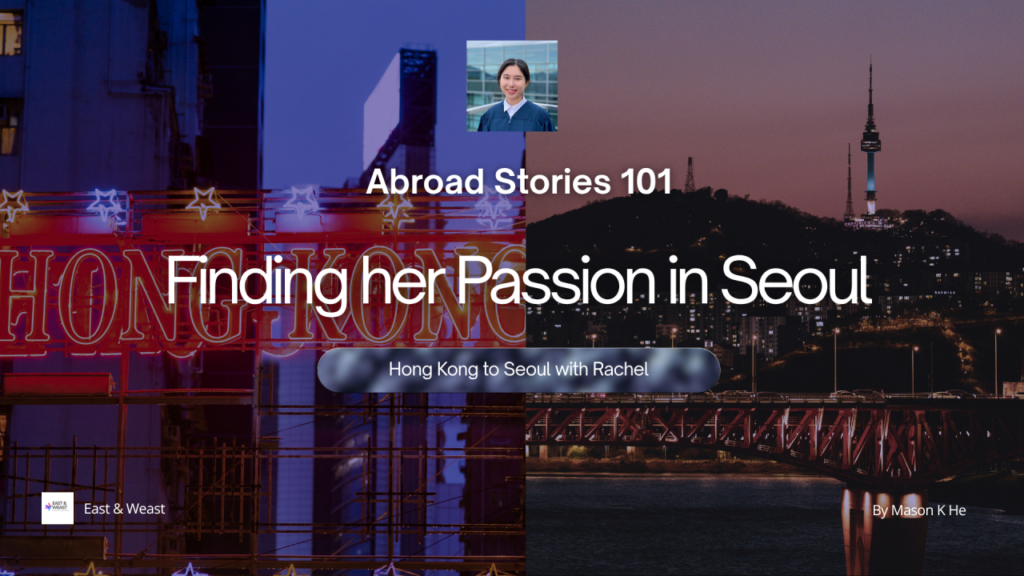
There is a comforting, almost magnetic pull to the traditional milestone path. You go to the right schools, secure the prestigious accounting degree, and land a coveted seat at a Big Four firm like PwC. For Rachel Yip , a trilingual professional born and raised in the vibrant, hyper-dense cultural incubator from Hong Kong, that blueprint was her reality.
But an interesting thing happens when you step inside the box, sometimes it only amplifies your hunger to explore the world outside.
“For the first chapter of my life, I followed that exact traditional path,” Rachel reflects, her tone striking a balance between gratitude and a fierce independent streak. “While that corporate foundation was invaluable, it also sparked a deeper ambition. My appetite for exploring the world, collecting unique life experiences, and stepping out of my comfort zone has only continued to grow.”

I sat down with Rachel to map out her transition from compliance corporate life to a raw, romantic, and occasionally freezing working holiday in South Korea, and how a sudden pivot to e-commerce giant Temu and a passion for mental health ultimately redefined her future.
The Cultural Imprinting of Hong Kong
To understand Rachel’s willingness to leap into the unknown, Hong Kong is a city where international diversity is the default setting.

“You don’t have to be rich to experience it; diversity is simply part of our local identity,” she explains. “Indomie from Indonesia is a staple childhood snack for us. We literally made Australian Lamingtons in school. When I finally traveled to Australia years later, I felt this instant rush of familiarity seeing them in a local supermarket. Hong Kong truly shaped my openness to the world.”
Like so many millennials and Gen Z(MZ) across Asia, her first portal into Korean culture was purely sonic. At eleven years old, the infectious hooks of Wonder Girls’ “Nobody” became her class’s official sports day cheering song. Soon came Girls’ Generation and the cultural phenomenon of the K-drama Boys Over Flowers.
“I still remember memorizing Girls’ Generation lyrics using Romanization, even though I didn’t understand a single word of Korean at the time”.
Driven by pure curiosity, she used her final summer break of primary school to study the language.
The Balance and the Realities of Corporate Detours

Rachel later attended the The Hong Kong University of Science and Technology (HKUST), double-dipping into numbers and minds by majoring in Accounting with a minor in Psychological and Behavioral Science. It’s an unconventional pairing, born from an evolving self-awareness. She recalls her university experience a little underwhelming as she didn’t perform as well as she would have liked in university. Her advice comes from her reflection on what she could have done better
“Choosing the right things to focus on. Everyone is exposed to the most opportunities in university. It’s great to try anything that catches your eye, but do make a decision to step away from commitments once you realize they aren’t suitable or rewarding”. In terms of my initial path, I believed entering the financial sector was the right path. I had the aptitude for organizing data and analyzing the business world,” she notes. “But I later realized my deeper passion lies in understanding the world from multiple perspectives and utilizing that knowledge to solve complex, human-centric problems.”
When asked how she balanced demanding academics with extracurriculars at HKUST, Rachel offers a refreshingly candid piece of advice rooted in unfiltered reflection:
She says
“University exposes you to an overwhelming amount of opportunities. Try anything that catches your eye, but make the conscious decision to step away once you realize a commitment isn’t suitable or rewarding. Choosing the right things to focus on matters more than doing it all.”
After graduation, reality threw its first curveball. She applied for an auditing role at PwC but arrived on day one to find she was met with a surprise – being allocated to compliance. She spent a year navigating the rigorous corporate structure, but the undercurrent of curiosity she felt during her university days, amplified by missing out on a traditional study abroad exchange, had finally reached a boiling point.
Shui Dao Qu Cheng (水到渠成): The Korean Pivot

Her departure from the corporate grind wasn’t a quick intuition to book her flight; it was a natural accumulation of desire.
“While I have always embraced new opportunities and sought out diverse life experiences, my decision to pursue a working holiday in Korea happened naturally — or as we say in Chinese, ‘水到渠成’. I reached a point where I knew compliance wasn’t my forever career, and I deeply wanted to experience a lifestyle and culture outside of my comfort zone while I still had the freedom to do so. Looking back, my curiosity about the world had been building ever since my university days, and not getting to do an exchange program back then definitely pushed me to finally take the plunge.”
While she initially weighed pursuing a full Master’s degree at elite institutions like Yonsei University’s Graduate School of International Studies (GSIS), the place where she and I crossed paths, the reality of financial independence caused her to opt for the flexibility of a working holiday. Living in South Korea, however, quickly stripped away the glossy, hyper-stylized veneer of K-pop music videos. Transitioning from an idealized tourist to a local resident living in a rooftop apartment brought immediate, physical challenges.
“Weather plays a massive role in shaping your experience,” Rachel points out. “Coming from Hong Kong’s mild 18°C winters, the intense Korean cold frequently made me sick. On the freezing days, it was too bitter to even take my hands out of my pockets to use my phone on the street. It feels romantic at first, but adapting to months of short daylight hours and sub-zero temperatures can feel incredibly isolating.”
Socially, the infrastructure presented its own nuances. While the student bodies at Yonsei and Korea University were deeply open-minded, fluent in English, and globally exposed, navigating life off-campus required thick skin.
“You do need to be prepared for being viewed and treated as an outsider. “Ultimately, to bridge that gap, achieving true fluency in Korean is vital. There is also a strict, explicit etiquette and politeness in daily life that can feel overwhelming to navigate as a temporary resident.”
Breaking the Narrative
For those looking at her journey through a curated social media lens, Rachel offers a grounding reality check on whether the working holiday route is right for everyone.
- The Financial Blueprint: “If your primary goal right now is financial stability or saving money, a working holiday may not be ideal for you.”
- The Necessity of Drive: “Nothing is guaranteed or handed to you. You must actively put yourself out there to make connections and seek opportunities every single day. Without that intrinsic motivation, it is incredibly easy to feel lost.”
- The Reality of the Job Market: “Breaking into the Korean job market as a foreigner without a local degree is exceptionally challenging, even with strong language skills. Navigating the logistics of settling into a new country makes it hard to maintain the single-minded focus required for high-level professional recruitment.”
Despite leaving Seoul with a longer bucket list than when she arrived, Rachel views her time there as a transformative crucible. She channels the perspective of author Han Kang to describe her evolution:
“ Of course, I still miss Korea, and once in a while, I reconsidered the master’s program at Yonsei University’s Graduate School of International Studies (GSIS) (where I met Mason!). But just as I was weighing my options, an unexpected and wonderful new chapter began: I received the job offer from Temu, and my boyfriend came into my life. When I start to write one book, I have some questions I want to deal with… And after I finish, I feel that I have reached the end of the question, and that I have changed because of that process.”
For Rachel, her time in Korea answered her questions about comfort zones, boundaries, and what truly matters to her.
The Next Chapter: E-Commerce, Crossroads, and Ikigai

True to the unpredictable rhythm of her career, Rachel’s return to the domestic market in Hong Kong came via another unexpected digital twist: she was scouted on Xiaohongshu (XHS) by the global e-commerce giant Temu, leading her into a fast-paced role within Mainland China’s tech ecosystem.
Yet, every detour has deliberately pointed her back toward human behavior. Today, Rachel is preparing for another massive regional pivot— possibly relocating to Singapore to reunite with her partner, and possibly adjusting to 365 days of tropical heat, a complete opposite from her time in Seoul.
Professionally, her compass has locked onto her true Ikigai—the Japanese intersection of what you love, what you are good at, what the world needs, and what you can be paid for.
“I’ve realized that contributing to the well-being of humanity on a personal level by raising awareness of mental health is my lifelong aspiration,” Rachel concludes elegantly. “I have an innate desire to understand the world through the perspectives of diverse people, moved by a desire to help myself and others achieve inner peace.”
With her sights set on an upcoming Master’s program in counseling, Rachel’s path is no longer defined by the rigid metrics of corporate compliance or the idealized romance of a study abroad brochure. It is defined by her own terms: fully realized, deeply felt, and beautifully 圓滿 (complete).
What are your thoughts on transitioning from corporate security to international exploration? Let’s discuss in the comments below.
Best,
Mason
East & West