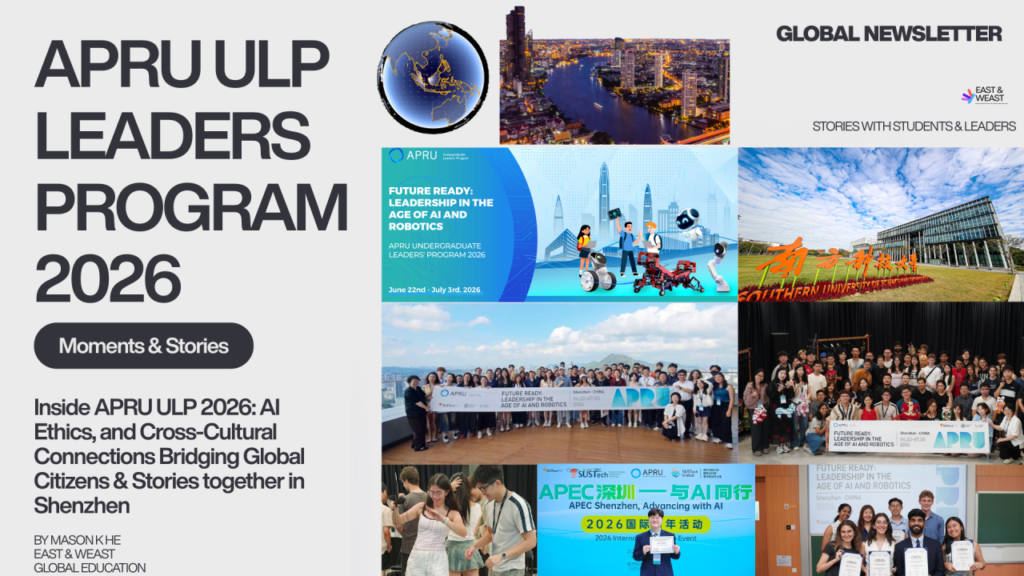

Welcome back to another issue of East & Weast! I am so excited to announce that this is my first joint newsletter about the APRU Undergraduate Leaders’ Program (ULP) program, which I am very invested in and have been learning about its goal to connect students across the pacific rim and worldwide. I had the honor to interview both student participants, peer mentor, and the APRU team on this year’s program in Shenzhen.
This is APRU , Undergraduate Leaders’ Program (ULP). The topic of the program is AI and Robotics. The Association of Pacific Rim Universities (APRU) is an association of 64 universities in 20 economies of the Pacific Rim. Formed in 1997, APRU fosters collaboration between member universities, researchers, and policymakers contributing to economic, scientific and cultural advancement in the Pacific Rim.
Program brief overview: During the program dates of June 22–July 3, 2026, Students learned more about AI & Robotics at the Southern University of Science and Technology (SUSTech), where innovation meets leadership. This immersive program dives into the future of AI and robotics, exploring how these technologies will transform human life, industry and society. Through design workshops, seminars, site visits to leading technology companies, and exchanges with scholars and practitioners, student participants will learn the depths of design, social, and leadership challenges that arise in an age where robotics is increasingly embedded in our daily lives.
Program Highlights: One can expect before applying is understanding cutting-edge research and practice in social robotics through workshops led by SUSTech faculty and international experts in design, automation, and human-robot interaction. Workshops, ethics of AI, exploring the AI and tech hub of Shenzhen, as well as cultural workshops are also part of this program.
1. Application Process:
Based on the website’s application guideline and my conversations with various students, you apply through the program and you have to be nominated by your university in order to apply. A personal statement is then required, but what caught my attention was the amount of interest on both similar and different reasons, but the most common reason that stood out was the location, China, and its technological status in being the perfect place to learn more in depth about AI, and also meeting others from different backgrounds. Most importantly, most students noticed this was a good opportunity to study and see AI upfront and learn the ethics behind using it.
The path to the ULP is a multi-layered journey defined by institutional filtering, administrative rigor, and competitive positioning. Students typically begin by applying through their local university departments or international link offices, where initial candidate pools are nominated, vetted, and narrowed down. From there, shortlisted files are elevated to central university systems for official nomination, with final selection ultimately conducted by APRU and host institution administrators at SUSTech. While participants described the administrative mechanics as relatively smooth, many found the experience emotionally nerve-racking due to the high stakes and low acceptance rates. Beyond standard transcripts and personal statements, selection committees heavily prioritized how applicants would serve as effective university ambassadors and what distinct cross-disciplinary or social-impact perspectives they could contribute to the global cohort.

2. Pre-Trip Anxieties and worries:
Ahead of their arrival in Shenzhen, participants experienced a compelling mix of eager anticipation and pre-trip apprehensions, balancing excitement for cross-cultural connection against practical and personal uncertainties. Across the cohort, students were eager to immerse themselves in China’s rapid tech evolution, step outside their academic comfort zones, and collaborate with diverse peers across the Asia-Pacific region. At the same time, their anxieties ranged from practical logistics—such as some navigating short-term visa applications, offline connectivity, and summer travel schedules—to personal challenges, including first-time solo international travel and feeling imposter syndrome when entering a STEM-focused environment with non-technical or non-STEM backgrounds. Ultimately, these initial worries quickly dissolved upon arrival, transformed by supportive administrative coordination, shared peer experiences, and a mutual commitment to actively engage with the program’s unique opportunities.
3. Eyewitness to Innovation: Shenzhen’s Tech Frontier
Experiencing Shenzhen firsthand offered participants a striking contrast between their home countries’ technological landscapes and China’s deeply integrated AI ecosystem. From drone food deliveries, palm-scanning payments, and autonomous street sweepers to rapid hardware prototyping in markets like Huaqiangbei, students were struck by how seamlessly advanced automation operates in daily life, and how an engineer could just buy the parts and create a product right there. Rather than seeing AI restricted to theoretical models or software applications, the cohort observed a society optimized for hardware velocity, immediate iteration, and widespread public adoption. This immersive experience highlighted that technology integration is ultimately a cultural choice, demonstrating how innovation, when paired with accessible resources and public trust, can move effortlessly from abstract concept to real-world application and coexist within society.
Student Voices on the Tech Integration in Shenzhen
- Shermaine (National University of Singapore): “Shenzhen felt optimized for hardware velocity, showing me how AI adoption actually looks on the ground far more than raw technical capability does.”
- Shreya (Nanyang Technological University): “My friends and I were very impressed by the convenience of the food delivery apps and how fast it was.”
- Penelope (University of Philippines): “In Shenzhen, young people are strongly encouraged to innovate because the environment and resources allow their ideas to materialize quickly.”
- Tyler (The Australian National University): “How quickly a society takes something up is a cultural choice rather than a technical inevitability.”
- Hannah (The University of British Columbia): “China has been using AI very efficiently, and it seems so seamless and natural to have AI live in your daily life.”
- Parmida (University of Auckland): “What really stood out to me was how fast-paced it was and how Shenzhen can bring innovation into a product so rapidly.”
- Nimish (University of Auckland): “You can just go to Huaqiangbei to get the part you want, use AI to create, and have the prototype ready in one day.”
- Joshua (The Chinese University of Hong Kong): “Seeing these technologies in person made the future of AI feel much closer, tangible, and real to me.”
- Dominga (Universidad de Chile): “Being there helped me reflect on how innovation can transform not only industries, but also the way people live and interact with their environment.”
- Genevie (University of California, Davis): ‘Being at Sustech, there was a lot of technology integrated there such as an elevator, you did not have to click a button, you would just hover it and then it would click for you.’
4. Unforgettable Connections & The Important Conversations of AI
Beyond the high-tech urban centers and rapid prototyping hubs, the true pulse of ULP included significant moments that created cross-cultural understanding, and cross-disciplinary revelations. For the cohort, discovering China meant seeing technology through a deeply human lens, where ethics, personal passion, institutional accountability, and lifelong friendships seamlessly intersected.
The journey was marked as much by quiet personal discoveries as by high-level academic discussions. Shreya found herself documenting her experiences daily, creating collages of photos, and one moment that caught my eye was her ballet studio class experience in Shenzhen from one of her photos. For Penelope and Parmida, they found Thomas Fisher’s lecture to be the highlight of the program. Penelope revealed that a quote from Thomas Fisher sparked urgent reflections on tech accountability and data infrastructure back home in the Philippines, while off-campus moments cemented deep personal bonds with the cohort.
Meanwhile, dorm room conversations were a pivoting open dialogue on global policy and intersectionality. Hannah recalled an important conversation engaged in open dialogues with her Kazakh roommate who is a student in South Korea over the human dimensions of data science, emphasizing the vital role women and underrepresented voices must play as AI evolves into a global political tool.
STEM vs. Humanities: Reimagining the Debates
One of the program’s most profound takeaways came from bridging distinct academic mindsets. Rather than a clash of values between technical builders and policy thinkers, participants realized the divide was simply a matter of workflow and perspective. As Tyler observed, humanities students often started with ethical constraints to shape a design inside the box, while STEM students started outside the box entirely before bringing their concepts back into governance frameworks with other participants.
At the same time, Shermaine highlighted that meaningful AI adoption for social impact must always begin with human relationships rather than technical capability, ensuring systems remain accountable, narrow, and human-anchored. For others, these ethical conversations inspired ideas for real-world utility, such as designing accessible travel and mapping apps to help international visitors navigate local restrictions and discover events with friends.
Collaborative Breakthroughs Under Pressure
These converging perspectives were put to the ultimate test during the high-stakes capstone challenge. Forced to balance technical feasibility with social impact in under 24 hours, Joshua’s cross-disciplinary team combined expertise across pharmacy, computer science, IT, and risk management to launch MediPal, which is an AI platform helping international travelers identify local medicine equivalents in China.

🎙️ Student Voices: Ethics, Community & Impact Highlight
“On a personal level, my absolute highlight was our very first group dinner at Nanto Asian City with what became the ‘Mǐfàn Gang’—over shared food and non-stop laughter, an instant bond formed that started a lifelong friendship.” — Penelope (University of the Philippines)
“It was a dream of mine to take ballet classes in other countries since dance is a universal language, and it was nice to experience the work ethic and tenacity of the Chinese in their own setting.” — Shreya (Nanyang Technological University)
“Good AI implementation begins with a non-AI question: what problem are we actually trying to solve? The goal is not to automate empathy—it is to reduce the surrounding friction so people have more time and attention for it.” — Shermaine (National University of Singapore)
“Humanities students started from the ethical position and tried to fit a design into it; STEM students started outside the box entirely. Most of the difference was not about values—what separated us was simply the order of operations.” — Tyler (Australian National University)
“Having these daily conversations with my roommate about the role of women producing AI made me realize how important my role in policy work is, especially when bringing an intersectional approach to underrepresented perspectives.” — Hannah (University of British Columbia)
“Our different academic backgrounds played an important role—combining healthcare knowledge, technology, and business considerations into one solution showed how diverse perspectives can create something innovative in a very limited amount of time.”— Joshua (The Chinese University of Hong Kong)
5. Honorable mentions
The capstone group project challenge pushed interdisciplinary teams to transform real-world observations into high-impact AI and robotics solutions under time pressure, earning several cohort projects standout recognition. Joshua’s team secured the coveted Design Creativity Award for MediPal, a healthcare application matching international visitors’ home prescriptions with local Chinese equivalents through seamless cross-disciplinary collaboration in pharmacy, computer science, and risk management—as Joshua noted, “Combining healthcare, tech, and business logic into one solution showed how diverse perspectives can create something innovative under pressure.”
Addressing sustainable hardware velocity, Tyler and Penelope’s team earned the Design for Good Award for AgriCart—a solar-powered autonomous robotic cart designed to carry up to 150kg for smallholder farmers, built entirely from accessible e-bike components to prioritize affordable, local repairability over rapid product obsolescence, with Tyler explaining that “The AgriCart was our attempt at showing you can maintain Shenzhen’s pace of hardware innovation while still building something made to last.”
Meanwhile, Parmida and Genevie’s team reframed common tourist friction points with Holoday, looking to design a platform centered on bridging the connection of travel and virtual reality, with Parmida sharing that “We wanted to put the problem in a new light-focusing on the emotional experience of traveling with loved ones rather than just logistics.”
6. Shaping Perspectives & Careers
Beyond the technical workshops and site visits, the ULP experience served as a powerful catalyst for reshaping academic trajectories and long-term career ambitions across diverse fields. Students from disciplines spanning public health, biotechnology, law, risk management, and political economy realized that their future careers cannot operate in isolation from emerging technologies like AI. Immersing themselves in Shenzhen’s ecosystem challenged the cohort to look past traditional industry boundaries, reaffirming that AI should be approached not as a replacement for human presence, but as an ethically governed, human-centered tool to empower professionals, streamline workflows, and address complex global challenges through interdisciplinary and cross-cultural collaboration.

🎙️ Student Voices: On Future Paths & AI in relation to their Major
- Joshua (Risk Management Science): “The program showed me that my future career does not have to be limited to one traditional field, but can combine risk management with emerging technologies to develop solutions with meaningful real-world impact.”
- Tyler (Law): “Shenzhen pushed me heavily toward intellectual property and AI law, where the question of who something is built for, and whose work it is built on, becomes a set of rules somebody actually has to write.”
- Penelope (Public Health): “Technology shouldn’t replace healthcare workers—if AI can reduce heavy administrative burdens, our medical personnel can spend less time on paperwork and more time delivering compassionate patient care.”
- Shreya (Sports Science): “Sports is so innately driven by human emotion and connection that our jobs can never be fully replaced by AI, though it is promising for refinement tasks.”
- Shermaine (Data Science, Analytics, Economics): “APRU made me see my career less as choosing a single job title, and more as building a combination of capabilities that allows me to connect technology with meaningful human problems.”
- Dominga (Molecular Biotechnology): “The program helped me understand that my future studies and career should not only focus on innovation, but also on responsibility, ethics, and the impact technology has on society.”
- Hannah (International Relations & Philosophy): “A lot of people say you should be in tech because tech is the future, but without politics or philosophy, how are we going to govern our people and maintain social justice?”
- Nimish (Chinese, History, Physics, Statistics): “It made me realize that whatever door I walk through next, I want to work with people from diverse backgrounds and hopefully use Chinese in my future career.”
- Parmida (Biomedical Sciences): “In the biomedical space, I am excited to move forward with AI but with the enhancements instead of using it as a tool to replace us, so probably improved diagnostics, assistance with surgery, and improved accuracy.”
- Genevie (Cognitive Science & Sustainability): “I think what was so eye-opening for me even with this program was the fact that I got to meet people from Europe, Africa, West Asia, who are so interested in coming to China to learn Mandarin.”
7. Program Lows & Navigating Challenges
While participants overwhelmingly rated the ULP experience as transformative, navigating the nearly two-week intensive program naturally presented cultural, logistical, and academic hurdles. Students encountered a steep learning curve adapting to China’s digital infrastructure, where foreign accounts faced friction using essential apps like Alipay and WeChat, as well as managing dietary requirements amidst unfamiliar local cuisine, regional spice levels, and limited vegetarian options. Academically, some participants noted a divergence in priorities: while foreign delegates were eager to debate AI ethics, data privacy, and technical hardware assembly, the program’s design-thinking framework and the local perspective focused more heavily on high-level theory, rapid innovation, and broad application rather than deep technical coding or critical policy constraints. Nevertheless, the cohort approached these challenges as valuable learning moments, even turning personal friction, such as dietary uncertainty, into inspiration for their group projects.
🎙️ Student Voices: On Challenges & Key Takeaways
- Parmida (University of Auckland): “We came in eager to talk about sustainability and user privacy, so it was an adjustment to see how the Chinese perspective focused much more on rapid innovation.”
- Nimish (University of Auckland): “One of the worries I had was, are we just innovating for the sake of it? But coming back to New Zealand, you think about how are we going to get things done? How about we do something new?”
- Penelope (University of Phillipines): “ I initially hoped for more hands-on technical work like coding or assembling hardware, but the two-week program focused more on theory, lectures, and design thinking instead. Looking back, that makes total sense given the short timeframe, and learning how to think like an ethical designer turned out to be just as valuable.”
- Shreya (Nanyang Technological University): “I noticed the younger Chinese students were a lot more introverted, whereas the older locals were surprisingly eager to communicate and talk with us.”
- Hannah (The University of British Columbia): “Because I was sick during parts of the trip, I realized that whatever energy you put into an immersive program like this is ultimately what you get out.”
- Tyler (The Australian National University): “The Chinese digital ecosystem takes a while to get used to—set up and test WeChat and Alipay before you leave so administrative barriers don’t affect your meals and transport.”
- Joshua (The Chinese University of Hong Kong): “Visiting the Huawei campus was a beautiful, fairy-tale experience, though I had hoped to learn more directly about their AI manufacturing processes.”
- Dominga (Universidad de Chile): “Because robotics and AI cover an extremely broad field, it was challenging to develop a deeper technical understanding within a short two-week design program.”
- Shermaine (National University of Singapore): “Communicating dietary needs across language barriers can be daunting, but that uncertainty became the direct inspiration for our AI meal-assessment project, mAIfan.”
- Genevie (UC Davis): “It was eye-opening, especially with group projects. Then you can really see how people behave and work in that setting, especially with their cultural behaviors go into play,”
8. Pro-Tips & Advice for Future Delegates

As future applicants look toward upcoming ULP cohorts, the main message from the student alumni is simple: don’t let hesitation, imposter syndrome, or a non-technical background hold you back from applying. Students emphasized that APRU seeks a rich diversity of perspectives across disciplines, making authenticity, clear personal intent, and open-mindedness far more valuable than a “perfect” technical profile. Going in with patience, flexibility, and a willingness to learn from every challenging moment—especially when navigating language or cultural differences, allows participants to adapt when the experience diverges from expectations. On a practical level, navigating China’s high-tech environment requires proactive preparation: setting up and verifying digital payment systems like WeChat and Alipay before departure, securing visas and eSIMs early, and leveraging translation or language-learning AI tools to build conversational confidence. Ultimately, stepping out of your comfort zone, shedding preconceived stereotypes, and arriving with genuine curiosity will yield rewards that far surpass the classroom: lifelong international friendships, broadened career horizons, and an unforgettable global perspective.
🎙️ Standout Advice from Alumni
“My advice would be to go with an open mind and be ready to learn from everything, even from the moments that feel challenging. Sometimes communication can be difficult, but be patient, flexible, and willing to adapt—that is part of what makes it meaningful.” — Dominga (Universidad de Chile)
“Don’t let fear or self-doubt stop you from applying. The benefits will almost always outweigh your doubts, and opportunities like this can change the way you see the world—and yourself.” — Penelope (University of the Philippines)
“Prepare an open mind and a willingness to step outside your comfort zone. You don’t need to know everything before you go—be curious, ask questions, and be ready to be surprised.” — Joshua (The Chinese University of Hong Kong)
“Before you apply, be clear about why this program rather than any other. The best conversations came from people who arrived with a specific question they wanted to work through.” — Tyler (The Australian National University)
“APRU actively looks for a diversity of perspectives. Even if your profile doesn’t seem to fit the exact theme on paper, show your passion and authenticity—corporate or perfect answers matter far less than what unique perspective you bring to the table.” — Hannah (The University of British Columbia)
“I would just stay curious and take advantage of being a student when it comes to traveling, and the most fulfilling learning experience during my time in college has been out of the country and if not, learning from students who are international at my school.” – Genevie (UC Davis)
9. Local Flavors, Hidden Gems, & The Power of “Nǐ Hǎo”
Beyond the lectures and tech tours, discovering Shenzhen meant sharing late-night meals, exploring scenic parks, and navigating the city’s vibrant food scene. From serene sunset walks along Shenzhen Bay and peaceful evenings at the SUSTech campus to bustling outings at Baoneng Global Mall, UpperHills, and Civic Centre, participants quickly identified their go-to sanctuaries. On the culinary front, local hotpot dinners, refreshingly unique fruit teas like Heytea, and comforting bowls of beef noodle soup became the ultimate bonding mechanism—turning tables of near-strangers into close-knit groups (including the affectionate creation of the “Mǐfàn Gang,” named after a favorite running joke about rice). When it came to language, students agreed that perfect vocabulary was far less important than basic courtesy, animated body language, and an eager attitude. Simple greetings like 你好 (nǐ hǎo) and 谢谢 (xièxie), paired with essential phrases for dietary restrictions and navigation, served as universal keys to breaking down cultural barriers and showing respect to their hosts. But the most important thing? Meeting new people and bonding friendships with people from different backgrounds and cultures is what resonated with every single participant’s experience in a program.

🎙️ Standout Local Tips
- Tyler (Australian National University): “The social side of a hotpot meal—sitting together and cooking for a long time—did more for a group of near-strangers than any structured activity could have.”
- Dominga (Universidad de Chile): “I would recommend learning is “这个多少钱?” (zhège duōshǎo qián?), which means “How much is this?” It is especially useful when visiting markets, ordering food, or buying something while exploring the city.
- Joshua (Chinese University of Hong Kong): “Exploring local brands like Heytea and enjoying the serene green spaces on the SUSTech campus made exploring China peaceful, unique, and truly memorable.”
- Penelope (University of Philippines): “Learning basic phrases like nǐ hǎo is a simple way of showing respect—as visitors, we shouldn’t expect to always be accommodated, but rather make an effort to appreciate the local culture.”
- Shreya (Nanyang Technological University): “One friend’s love for rice and saying ‘米饭’ (mǐfàn) became an iconic, funny memory for us that we even paid homage to by creating a social media group with that name.”
- Shermaine (National University of Singapore): “Saying 你好 (nǐ hǎo) is the first act of openness to a stranger—a limited vocabulary never prevents connection when you have the willingness to begin.”
- Hannah (University of British Columbia): “If you have allergies, make sure to learn how to say it accurately in the local language—it saves you from misunderstandings while exploring food!”
- Parmida (University of Auckland): “The art of body language and hand gestures will carry you further than any phrase; hand gestures got me through ordering malatang alone on campus!”
- Nimish (University of Auckland): “When communicating across language barriers, dialing up your reactions and expressions can be surprisingly helpful in making yourself understood.”
10. Stories from a Peer Mentor
Serving as both a participant and a peer mentor from SUSTech, Adelbert approached the 2026 APRU Undergraduate Leaders’ Program with a relaxed, open mindset, to ensure students felt immediately welcomed, accepted, and comfortable. Beyond assisting with daily logistics, from navigating English-Chinese translations and ordering takeout to guiding city tours and delivering a morning McDonald’s breakfast for a student during a high-stakes exam.
Adelbert saw his core role as building bridges. Through shared meals, late-night chats, and interdisciplinary collaboration across Shenzhen, he watched a cohort of international strangers transform into a tightly knit community in just 12 days. Connecting deeply with fellow Indonesian participant Joshua over shared roots, jokes, and Indomie, Adelbert highlighted how programs like the ULP showcase host university SUSTech and Shenzhen’s Silicon Valley atmosphere while empowering students to step outside their comfort zones, build lifelong bonds, and embrace new global perspectives.
Peer Mentor Highlights & Words of Wisdom
“I realized that being myself was the best way to be approachable—so I did whatever I could to crack jokes, lighten the mood, and help everyone feel welcomed. By the end of the 12 days, a bunch of strangers became a close-knit community. Revisiting the spots where we had dinner together constantly reminds me of the special moments and conversations we shared. My advice to future participants is simple: step out of your comfort zone. Make friends and have deep conversations with strangers, because life was meant to be enjoyed, not feared. For anyone who is traveling to China for the first time, I choose 加油 (jiāyóu, ‘Keep going! / You’ve got this!’) because during the capstone project, everyone worked tirelessly. As teammates and friends, we are there to support and encourage each other.”
11. Perspectives from the ULP Team, David
I had the honor to interview the ULP team member, David, who gave insights into his career trajectory at APRU and what we can expect for next year’s program.
1. What was your journey like getting to work at APRU?
- “Wow, this is a long story, but I’ll try to keep it short. Before joining APRU, I worked at the Chinese YMCA of Hong Kong in the International and Mainland Affairs Section, where I coordinated international exchange programs, somewhat similar to the ULP. My journey with the YMCA started much earlier in my hometown in Ibagué, Colombia. I joined it, as it gave me opportunities to serve the community while also gaining international experience through internships abroad. Over the years, I worked as a camp counselor in Alabama, Hawai’i, and Hong Kong, among other places. Those experiences exposed me to different cultures, perspectives, and ways of thinking. They helped shape who I am today and made me a Global Citizen. Looking back, I think those experiences were significant in preparing me for my role at APRU, where connecting people and fostering global understanding are at the heart of what we do.”
2. From this year’s program in Shenzhen and topic on AI and robotics, what was the program process and development like from your end?
- The preparation of a program like the ULP is a long and highly detailed process. In fact, just a few weeks ago, we already started working on ULP 2027 together with the next host. For this year’s program, we maintained constant communication with the organizing team at SUSTech from beginning to end. Together, we worked to develop a program that was academically rigorous, engaging, culturally enriching, and relevant to the rapidly evolving fields of AI and robotics. There are many moving parts behind the scenes, from designing the academic content to coordinating logistics and student experiences. One of our main priorities at APRU is ensuring that participants have access to a high-quality program that meets the standards our member universities expect. Thanks to the professionalism, and dedication of the SUSTech team, I am confident that we achieved that goal and delivered a meaningful experience for everyone involved.”
3. Many students I talked told me they really enjoyed their experiences from the program, noting it was eye-opening, but most importantly the connections they made and the new AI perspectives they have gained – which is very different from what they know and are used to in their home country. Did you happen to have any meaningful experiences or conversations with any of the participants during the program?
I have to say that I am privileged to witness the program firsthand. Like many of the students, I was impressed by how developed and innovative Shenzhen is. From drone deliveries and dancing robots to the integration of technology into daily life, many things left a strong impression on me. However, what was most meaningful was seeing how quickly students connected with one another. Throughout the program, I watched participants build friendships across cultures, disciplines, and backgrounds. It was inspiring to see them engage with different perspectives, challenge their own assumptions, and find common ground despite their differences. For me, that is one of the most valuable aspects of the ULP. While students certainly learn about topics such as AI and robotics, they also learn about their own selves and each other. Those conversations, friendships, and shared experiences often become just as impactful as the academic content itself.”
4. Did you have any expectations from the students/participants during the program? Was there anything specific in the program you were a little bit worried initially?
- “My personal expectation was that the program would be both enriching and enjoyable for participants. I hoped the lectures would challenge students’ understanding of AI while also introducing important new concepts such as human-centered approaches to technology, something the School of Design did exceptionally well. As with any international program, there are always small concerns at the beginning. One hopes students will actively engage with the content, embrace new perspectives, and appreciate the effort that goes into creating these opportunities. One also hopes they will step outside their comfort zones and connect with people from different backgrounds. I am very pleased because I believe we achieved those goals.”
5. Any tips for students who may be interested in the APRU program next year. And not sure if you can tell us, but any info or tips on what we can expect?
“The best tip I can give is to follow APRU’s social media platforms and subscribe to our student newsletter. We promote all of our programs through these channels, making them the fastest and easiest way to stay informed about upcoming opportunities. As for next year’s ULP, we can already share that it will be hosted by Universitas Indonesia in Jakarta. Students can expect another exciting opportunity to learn, collaborate, and engage with peers from across the Asia-Pacific and beyond. If students would like to receive updates and be among the first to know when applications open, I strongly encourage them to sign up for our newsletter and keep an eye on APRU’s communication channels.”
Conclusion
Many thanks to all the collaborators of both participants and leaders for this special joint newsletter project covering APRU. I hope everyone enjoyed this first joint global newsletter and gained new insights from both students and leaders side of the program. Please see full list of contributors below:
Thanks to all the contributing participants in this article:
Penelope Ann Bacares (University of Philippines)
Tyler Withnall (Australian National University)
Shermaine Kuah (National University of Singapore)
Shreya Vidya Nair (诗雅) (Nanyang Technological University)
Joshua Viencent Tandibrata (Chinese University of Hong Kong)
Hannah Kim (University of British Columbia)
Parmida Jafarian (University of Auckland)
Nimish Milan Singh (辛耀寧) (University of Auckland)
Dominga Eben Amor (Universidad de Chile)
Genevie Hong (UC Davis)
Adelbert Reinhard Riang (SUSTech)
David Quimbayo (APRU, Program Manager)
Best,
Mason K. He
East & Weast