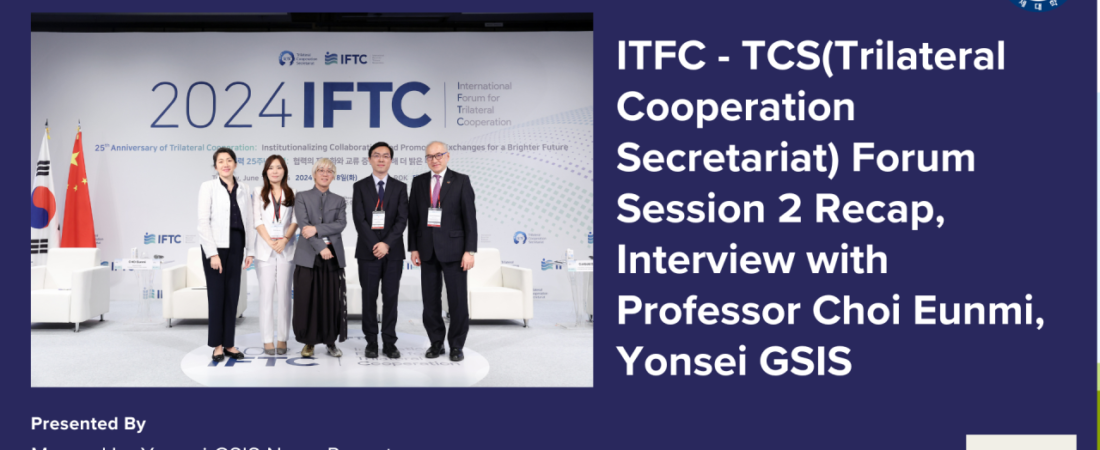
Hi everyone! I had the honor to attend the TCS(Trilateral Cooperation Secretariat) Forum last week(second session) and thought this would be a great article to do a recap of Session 2. Thank you to Yin for assisting with the application process and affiliated staff for their efforts to arrange this event. This is the first edition of my other Newsletter series titled ‘MKH Productions’ which will primarily serve as an extracurricular newsletter – school, networking events, etc.
Introduction of the organization
IFTC Introduction
International Forum for Trilateral Cooperation (IFTC) is TCS’s annual flagship event that brings together eminent scholars/policy makers to share and offer new insights into the political climate, economic cooperation, and socio-cultural ties among China, Japan and the ROK. IFTC is held on a rotational basis among the three countries, targeted at participants of government dignitaries, experts, scholars, business leaders, journalists and civil society leaders from the three countries. The inaugural IFTC was held by the Ministry of Foreign Affairs of the ROK and Sejong Institute in Seoul, ROK, in 2011, commemorating the launch of the TCS. The TCS has succeeded the initiative and organized the IFTC since 2012. In 2015, IFTC was changed to be held on a rotational basis in the three countries. Due to COVID-19 outbreak, IFTC 2020 was postponed to 2021. This year, the forum was held in Seoul, South Korea on June 18, 2024.

TCS
The Trilateral Cooperation Secretariat (TCS) is an international organization established with a vision to promote lasting peace, common prosperity and shared culture among the People’s Republic of China, Japan, and the Republic of Korea.
Upon the agreement signed and ratified by each of the three governments, the TCS was officially inaugurated in Seoul in September 2011. The establishment of TCS marked a significant milestone and achievement in terms of the institutionalization of the trilateral cooperation among the three countries started in 1999.
- TCS main projects
- International Forum for Trilateral Cooperation (IFTC)
- Trilateral Journalist Exchange Program (TJEP)
- Young Ambassador Program (YAP)
- Trilateral Youth Summit (TYS)
- Trilateral Teacher’s Exchange Program-Public Awareness of Environmental Protection (TTEP)
- Trilateral Entrepreneurs Forum (TEF)
- CJK FTA Seminar
Session 2: Digital Nexus: In Search of Solution for Descending Mutual Perception in Trilateral Cooperation: This session had experts and activists from the three countries and international organizations discussed the impact of social media (SNS) on public perception and explored solutions for fostering an inclusive digital transformation to improve mutual understanding.

Recap
The moderator for this session was Jie-Ae Sohn , the Ambassador for Cultural Cooperation, Ministry of Foreign Affairs of Republic of Korea. She is also currently an invited professor at the Graduate School of International Studies(GSIS) at Ewha Women’s University and hosts weekly talk show ‘The Globalists’ on Korea’s only English-language TV and Radio Channel Arirang TV .
Session 2 had four outstanding speakers: Choi Eunmi, Yamashita Tomohiro, Wang Zhongyuan, and Ganbold Baasanjav. Four of these speakers discussed on the range of digital topics; Choi Eunmi focused on Digital Literacy, Yamashita Tomohiro focused on Trilateral Cooperation for the Next Generation, Wang Zhongyuan focused on the Impact of AI Development on the Cultures of China, Japan, and Korea, and Ganbold Baasanjav focused on the impact of digital transformation on communication and perspectives. After an informative presentation, it was Q&A time and there were various students from each country that asked detailed and interesting questions to the speakers. Afterwards, many students from the audience engaged with the speakers with insightful and detailed questions and served for an opportunity for them to network at this trilateral cooperation event. In the next slide, I will be focusing only on Choi Eunmi’s presentation briefly and proceed with the short interview.
Choi Eunmi, Research Fellow, Asian Institute for Policy Studies

Choi Eunmi’s presentation focused on the Digital literacy: A Necessity in the Digital Transformation Era for building Mutual understanding. The background of the digital transformation is the fact that information is readily accessible wherever, thanks to the advancement of the Internet. While this brings convenience, speed, and efficiency, challenges such as accuracy, reliability, and bias may arise.
“The same trend is apparent in perceptions of other countries as well” When examining international relations, negative perceptions of other countries often provoke strong reactions, particularly when bilateral relations are strained. Take for example, the ‘No Japan’ movement in South Korea erupted significant anti-Japanese protests.
Fast forward to 2024, relations between the two improved and now travel to Japan and interest in Japanese culture, as well as further exchange has been encouraged.
Key takeaway – while the digital technology presents a dual nature(positive or negative), the need to understand digital literacy and establishing a groundwork of mutual understanding that adapts to evolving trends is apparent.
Interview:

- Can you briefly introduce yourself and share a little bit about your academic background and your current work? And then also, maybe one thing we do not know about you? “My name is Choi Eunmi I’m working at the Asan Institute for Policy Studies. I’m also a lecturer at the Hankuk University of Foreign Studies. I also lectured at the Yonsei GSIS. There is the 60th anniversary between Korea and Japan normalization, which I am doing some research work and also doing some kind of, you know, organizing some conferences for anniversary normalizations between Korea and Japan, so you can look forward to that next year.”
- How did you come to Yonsei GSIS? What expectations did you have before coming to GSIS? “ It was actually first time to lecture in Korean, not English. So I thought it was very interesting. And also I wanted to meet many international students. In my class there were some Japanese students and Chinese students, and also some South East-Asian students. in the Asian field. So for me it was a very very good experience and I also learned a lot of things from them.”
- For the people who couldn’t come to the events today, what are some things you wanted to say? “So some people are just, you know, it’s very easy to talk with the people who have the same idea with me. But we don’t want to have more talk with someone who has different ideas(compared to me). But I really want to see the young generation to have more chances to have a conversation and talk about their experience especially to living here in Korea.”
End of Interview
Conclusion
Once again, I would like to express my gratitude to Li Guanyu, Director at Trilateral Cooperation Secretariat, who was able to support my participation at this event and approve of my interview with Professor Choi Eunmi. As an American, the event gave further insights on how trilateral cooperation and its progress to understand and work with each other. I hope to all future subscribers, connections, or any reader on LinkedIn found this article a fun read. Stay tuned for more content for MKH Productions as well as my HR-focused project – HR Hour.
End
Mason He, Yonsei GSIS, News Reporter
MKH Productions